In the event you’ve been being attentive to mainstream diet commentary currently, you’ve got most likely encountered a curious narrative: that considerations about seed oils are overblown, that the science would not help the alarm, and that worrying in regards to the vegetable oils in your meals is — as one widespread speaking level places it — “stepping over $100 payments to select up pennies.”
This dismissive angle has been spreading via podcasts, social media, and well being influencer circles. And I’ve to be direct with you: it represents both a profound misunderstanding of fundamental biochemistry or one thing extra troubling. If you see a parade of influential voices all singing from the identical hymn sheet — one which conveniently aligns with the pursuits of a multi-billion-dollar vegetable oil trade — it’s a must to no less than take into account who advantages from this message.
Think about this: your great-grandparents consumed nearly no soybean oil. By 1999, the common American consumed over 1,000 instances extra. This is not a dietary tweak. It is a full metabolic overhaul that our our bodies have been by no means designed to deal with.
The mainstream logic is straightforward: Seed oils decrease LDL ldl cholesterol. Decrease LDL means much less coronary heart illness. Subsequently, seed oils are good for you. Case closed — or in order that they’d have you ever imagine.
However this syllogism has a deadly flaw that anybody aware of mitochondrial biology would instantly acknowledge. It assumes that the one pathway via which seed oils might trigger hurt is thru LDL ldl cholesterol. This assumption is not merely mistaken — it reveals a basic ignorance of lipid biochemistry and mitochondrial physiology.
The Arguments Being Made — And Why They Fall Aside
The mainstream argument has some legitimate factors, which makes it all of the extra essential to grasp the place it goes fatally mistaken. The mainstream well being influencers making these claims aren’t solely mistaken about every thing:
• Trans fat are problematic — Early research substituting polyunsaturated fat for saturated fat have been confounded by trans fat in margarines, which contained 25% to 40% trans fatty acids. This can be a authentic criticism of research just like the Minnesota Coronary Experiment and Sydney Food plan Coronary heart Research.
• LDL ldl cholesterol is a danger issue for heart problems — The Mendelian randomization information they cite is strong — lifelong publicity to elevated LDL is related to elevated CVD danger.
• Saturated fats does elevate LDL ldl cholesterol — This isn’t in dispute.
These factors are legitimate. They’re additionally virtually fully irrelevant to the query of whether or not seed oils are contributing to the trendy epidemic of metabolic illness. The traditional diet institution has constructed its whole case on a basis that misses the precise mechanisms of hurt.
The Deadly Flaw: LDL Tunnel Imaginative and prescient
The complete analytical framework being promoted might be summarized merely:
1. Seed oils decrease LDL ldl cholesterol
2. Decrease LDL ldl cholesterol reduces CVD danger
3. Subsequently, seed oils are helpful (or no less than impartial)
This argument assumes that the one pathway via which seed oils might trigger hurt is thru LDL ldl cholesterol. That is the equal of analyzing the well being results of cigarette smoking whereas focusing completely on heart problems and ignoring lung most cancers.
The defenders of seed oils are asking the mistaken query. They ask, “Do seed oils trigger coronary heart illness?” The right query is: “Do seed oils trigger the systemic irritation and mitochondrial dysfunction that underlies coronary heart illness AND diabetes AND neurodegeneration AND most cancers AND liver illness AND nearly each different continual illness of recent civilization?”
The reply to that query could also be sure, because the proof suggests. And the traditional diet institution by no means even asks it.
Coronary heart Illness Is Not Simply About LDL
The mainstream narrative frames coronary heart illness as an LDL story: Particles penetrate the arterial wall, get oxidized, macrophages engulf them, foam cells type, plaques develop. Cut back LDL, scale back plaques, scale back coronary heart assaults. Easy.
However this can be a cartoon model of cardiovascular pathophysiology. The precise drivers of atherosclerosis embrace:
• Systemic irritation — Elevated IL-6, TNF-α, and CRP all speed up plaque formation and destabilization
• Endothelial dysfunction — The lack of blood vessels to dilate correctly, which precedes plaque formation
• Oxidative stress — Which damages the arterial wall and promotes LDL oxidation
• Insulin resistance — Which is independently related to CVD danger even controlling for LDL
• Mitochondrial dysfunction — Which impairs power manufacturing in coronary heart cells and vascular clean muscle
Each single one among these elements could also be made worse by linoleic acid (LA) via mechanisms that don’t have anything to do with LDL particle depend. The seed oil defenders deal with the sparks whereas ignoring the gasoline, the kindling, and the truth that your complete forest is already smoldering.
The Irritation No person Needs to Discuss About
So, if LDL is not the entire story, what’s? The reply lies in a phrase the seed oil defenders not often point out: irritation. That is beautiful, as a result of LA is the precursor to arachidonic acid, which is the substrate for prostaglandins, thromboxanes, and leukotrienes — all potent inflammatory signaling molecules.
However much more importantly, when LA oxidizes, it generates a household of poisonous breakdown merchandise collectively known as OXLAMs. These compounds — notably two named 9-HODE and 13-HODE — have been related to continual illness.1 They could change on inflammatory signaling pathways, enhance liver manufacturing of inflammatory chemical compounds, and activate immune cells in ways in which promote continual illness.
My 2025 assessment printed within the World Journal of Scientific Oncology describes how extra LA could create oxidative lipid peroxidation, the chain response that happens when fat are broken by oxygen, mitochondrial dysfunction, hormonal-inflammatory amplification, and intestine dysbiosis that collectively create what the assessment calls a “pro-cancer terrain.”
The determine above exhibits how an excessive amount of LA from seed oils clogs your cell’s power system.2 However this is not nearly most cancers. That is in regards to the systemic physiological dysfunction which will manifest otherwise in several tissues: within the arteries it turns into atherosclerosis, within the mind it turns into neurodegeneration, within the liver it turns into fatty liver illness, within the pancreas it turns into diabetes.
The traditional place defends seed oils by claiming they do not trigger coronary heart illness. This fully ignores that they could contribute to the underlying pathophysiology that drives coronary heart illness AND different continual ailments.
The Lacking Chapter: Mitochondrial Dysfunction
The mainstream diet institution devotes nearly no dialogue to mitochondrial perform when defending seed oils. This omission is inexcusable as a result of it is the place crucial harm could happen. Let me clarify this in accessible phrases, as a result of that is the science that seed oil defenders apparently do not know exists.
Your mitochondria are tiny energy crops inside each cell — and so they produce roughly 95% of all of the power that retains you alive. After they fail, every thing fails. With out practical mitochondria, your cells cannot work correctly. That is as basic as biology will get.
Inside every mitochondrion is a construction known as the inside mitochondrial membrane.3 This membrane homes the electron transport chain — the precise equipment that produces your mobile power. And here is the vital level: This membrane accommodates a particular fats known as cardiolipin.4,5 Cardiolipin is just like the lubricant that retains your power equipment operating easily — it has a singular four-tailed construction discovered virtually nowhere else in your physique.
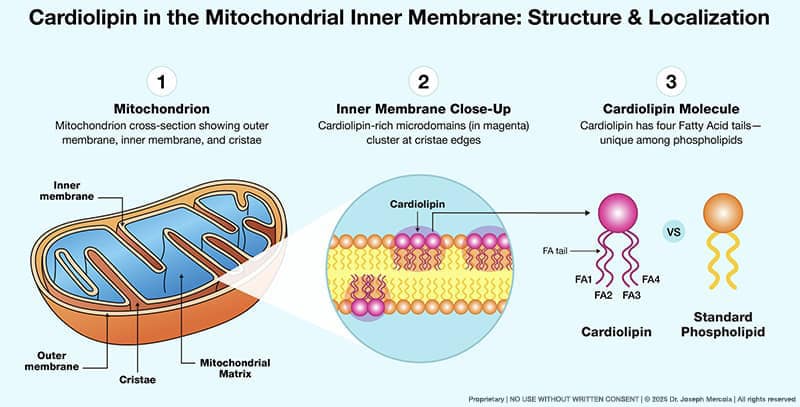
The determine above exhibits the place cardiolipin lives inside your mitochondria and why it issues for power manufacturing.6 Cardiolipin requires LA to perform correctly.7 That is really important — there is a uncommon genetic illness known as Barth syndrome the place individuals can not correctly incorporate LA into their cardiolipin.8 They’ll develop coronary heart failure and should die prematurely. So LA in the appropriate place, in the correct quantity, is critical for all times.
However here is what the traditional narrative fully misses: Cardiolipin makes up solely about 20% of the inside mitochondrial membrane. The opposite 80% consists of different phospholipids which can be NOT purported to be loaded with LA.
If you devour extreme dietary LA — as nearly all People now do — that extra would not simply go into cardiolipin the place it belongs. It accumulates in that different 80% of the membrane the place it will possibly create severe issues.
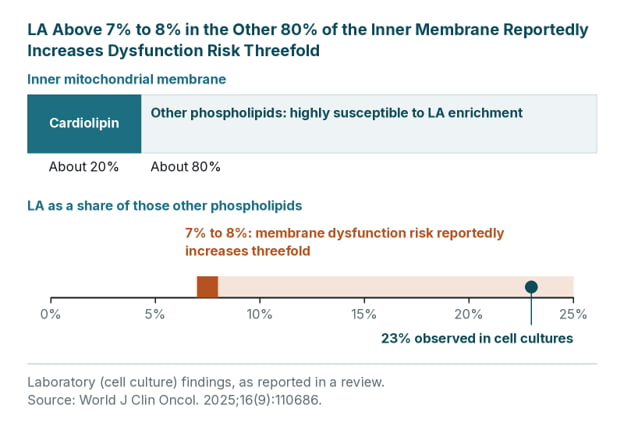
Determine 1. Linoleic acid above 7% to eight% within the non-cardiolipin 80% of the inside mitochondrial membrane reportedly will increase dysfunction danger threefold.
My 2025 assessment states explicitly: “The remaining 80% of the IMM contains non-cardiolipin phospholipids, together with phosphatidylcholine and phosphatidylethanolamine, that are extremely vulnerable to LA enrichment. When LA in these phospholipids exceeds 7% to eight%, with ranges like 23% noticed in cell cultures, membrane dysfunction danger reportedly will increase threefold.”9 The determine under exhibits how consuming an excessive amount of LA can set off a series response that damages your mitochondria and drains your power.10
The Mechanism of Injury
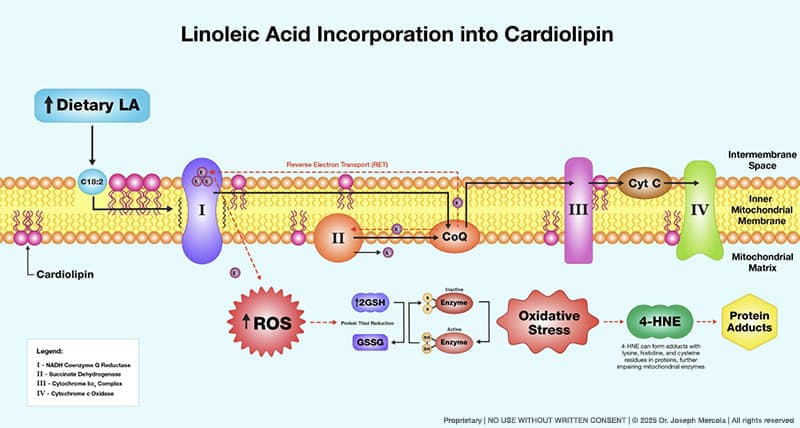
LA has a chemical construction that makes it extremely weak to oxidation. Think about a series with fragile hyperlinks that break simply when uncovered to oxygen — LA has two of those weak spots, making it much more inclined to wreck than saturated fat and even most different unsaturated fat.11
The electron transport chain (ETC) continually generates small quantities of reactive oxygen species (ROS) as a byproduct of regular power manufacturing. When these ROS encounter LA-enriched membranes, they set off a peroxidation cascade that generates extremely poisonous compounds, notably 4-hydroxynonenal (4-HNE).12
4-HNE is, based on printed analysis, probably the most studied lipid peroxidation product with pleiotropic capabilities.13 It would not simply float away harmlessly. It could actually type everlasting chemical bonds with the proteins of the electron transport chain itself.
A 2024 paper in Vitamins states explicitly: “Extreme consumption of vegetable oils resembling soybean and canola oils containing ω-6 polyunsaturated fatty acids is taken into account probably the most essential epidemiological elements resulting in the development of lifestyle-related ailments.”14 This will create a vicious cycle:
1. Extra dietary LA incorporates into mitochondrial membranes
2. Regular power manufacturing generates ROS
3. ROS oxidize the surplus LA
4. Oxidation generates 4-HNE
5. 4-HNE damages electron transport chain proteins
6. Broken proteins leak extra electrons, producing extra ROS
7. Extra ROS oxidize extra LA
8. Extra 4-HNE is generated
9. Mitochondrial perform progressively deteriorates
10. ATP manufacturing — your cells’ power foreign money — declines
11. Cells dysfunction or die
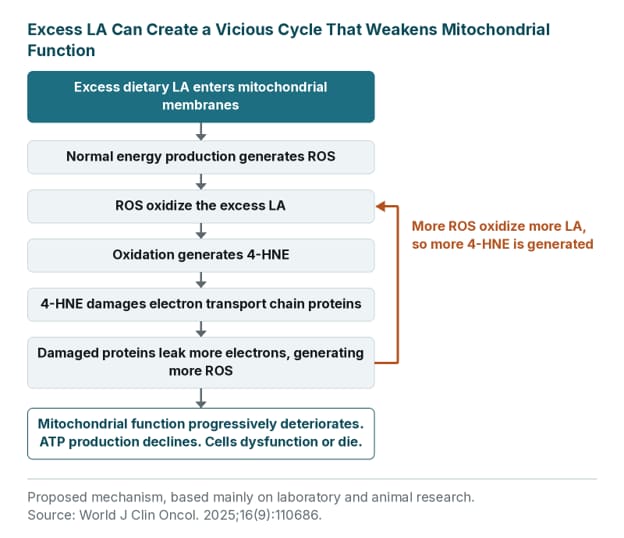
Determine 2. Extra LA can create a vicious cycle of oxidation and harm in mitochondria.
That is constructed on biochemistry printed in journals together with Cell Loss of life & Differentiation,15 Nature,16 and my assessment printed in Free Radical Biology and Medication.17 The traditional diet institution discusses none of it. They discuss LDL particles whereas this metabolic harm could unfold within the mitochondria of cells all through your physique.
Reductive Stress: The Idea the Mainstream Would not Know

The determine above exhibits how your mitochondria make power by shifting electrons via a sequence of steps, which additionally creates a move of protons that powers ATP manufacturing.18 The traditional diet institution mentions oxidative stress when discussing seed oils. They by no means point out reductive stress. This omission reveals one other basic hole in understanding.
For many years, the free radical principle of growing older centered completely on oxidative stress — the concept extra reactive oxygen species overwhelm antioxidant defenses and harm cells. However rising analysis has recognized an equally essential phenomenon: reductive stress.

The determine above exhibits how having too many electron-carrying molecules (like NADH) overloads your mitochondria and triggers a dangerous chain response.19 Reductive stress happens when the provision of electron donors exceeds the capability of the mitochondrial electron transport chain to course of them.20 When you could have too many electrons coming in and never sufficient capability to deal with them, electrons accumulate the place they should not be and begin reacting with oxygen prematurely.
Here is the vital perception: reductive stress could cause oxidative stress.21 An extra of decreasing equivalents (electron-carrying molecules like NADH that ship electrons to the mitochondria) results in electron leakage, which generates the very ROS that trigger oxidative harm.
A landmark 2020 paper in Nature reported that elevated hepatic NADH/NAD+ ratio — reductive stress — mediates the results of a typical gene variant on metabolic traits, together with glucose tolerance.22 This wasn’t correlation; utilizing genetic instruments to immediately decrease the ratio affected these traits in mice.
LA could contribute to reductive stress via two converging mechanisms. First, excessive dietary fats consumption will increase fatty acid oxidation, flooding the system with electrons. Second, 4-HNE harm to electron transport chain proteins impairs their capacity to course of these electrons.
The potential consequence: extra electrons coming in, much less capability to course of them. Extreme reductive stress. Large oxidative harm. Progressive metabolic dysfunction.
The mainstream argument is that energy are the primary driver of weight problems and metabolic illness. This can be a half-truth that obscures the mechanism. LA-induced mitochondrial dysfunction and reductive stress could also be drivers of metabolic inflexibility, which then could promote the caloric imbalance that results in weight problems.23,24 The seed oils could also be upstream. The determine under exhibits how long-term excessive blood sugar and extra vitamins harm your cells in two phases.25

The Historic Proof Being Dismissed
Seed oil defenders dismiss considerations in regards to the unprecedented improve in LA consumption as a “naturalistic fallacy.” That is vastly oversimplified.
The info printed within the American Journal of Scientific Diet are stark: estimated per capita consumption of soybean oil elevated greater than 1,000-fold from 1909 to 1999.26 The provision of LA elevated from 2.79% to 7.21% of complete power consumption.
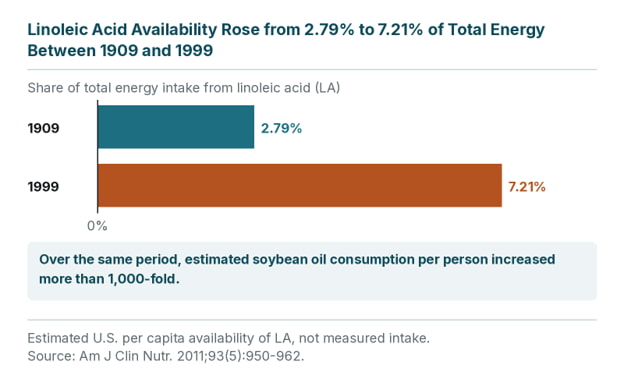
Determine 3. Estimated U.S. availability of linoleic acid rose from 2.79% to 7.21% of complete power between 1909 and 1999.
This isn’t a minor dietary shift. This can be a substantial change in a basic substrate for human metabolism, occurring over a single century — a blink of an eye fixed in evolutionary phrases.
And this dietary change has been accompanied by a large shift in human physique composition. A scientific assessment printed in Advances in Diet analyzed research measuring subcutaneous adipose tissue LA focus in U.S. cohorts from 1959 to 2008.27 The discovering: Adipose tissue LA elevated by 136%.
The correlation between dietary LA consumption and adipose tissue focus was extraordinarily robust (R² = 0.81). This isn’t theoretical concern — we now have basically altered the fatty acid composition of human physique fats.
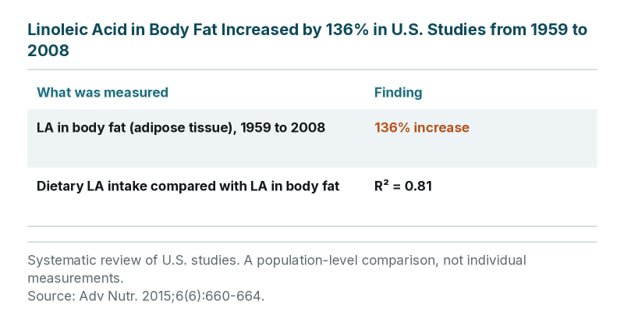
Determine 4. Linoleic acid in physique fats elevated by 136% in U.S. research from 1959 to 2008.
Why does this matter? As a result of adipose tissue is just not merely an inert storage depot. It is an endocrine organ that produces inflammatory cytokines. When people shed pounds, they mobilize fatty acids from adipose tissue into the bloodstream. If that tissue is 136% extra enriched with extremely oxidizable LA than it was two generations in the past, the metabolic penalties could also be profoundly totally different.
LA has a half-life of about two years in your fats tissue. This implies a 50-year-old carries of their physique a chemical document of most of the seed oil-laden meals they’ve eaten for many years. Your physique remembers, even when you do not.
This time-delayed burden could assist clarify why regulatory our bodies have been gradual to behave — whilst new science continues to spotlight danger. Frances Sladek, Ph.D., a professor of cell biology on the College of California, Riverside, who has extensively studied soybean oil’s metabolic results, supplied a stark warning:28
“It took 100 years from the primary noticed hyperlink between chewing tobacco and most cancers to get warning labels on cigarettes. We hope it will not take that lengthy for society to acknowledge the hyperlink between extreme soybean oil consumption and damaging well being results.”
Her group’s analysis has proven that soybean oil consumption can promote weight problems in mice, underscoring the organic results of this industrial oil.
This connection between seed oils and continual illness is additional explored in my printed analysis in Cureus, “Seed Oils as a Hypothesized Contributor to Heart Disease: A Narrative Synthesis,” which synthesizes over 200 references suggesting that the fast adoption of LA-rich industrial seed oils within the early 1900s preceded the surge in coronary coronary heart illness deaths by 10 to twenty years — the approximate timeframe wanted for atherosclerotic plaques to develop — and that LA oxidation generates the identical inflammatory aldehydes like 4-HNE now being implicated in weight problems.
The Hadza, a contemporary hunter-gatherer inhabitants that represents our greatest approximation of ancestral dietary patterns, have LDL levels of cholesterol of fifty to 70 mg/dL, very low charges of heart problems, and low charges of metabolic illness. They devour nearly no industrial seed oils.
Whereas the Hadza differ from fashionable populations in some ways past seed oil consumption, they exhibit that the metabolic dysfunction we take into account “regular” is just not inevitable for people. This isn’t a naturalistic fallacy. This can be a management inhabitants that implies what human metabolism seems to be like within the absence of a 1,000-fold improve in soybean oil consumption.
The Intestine Connection
The mitochondrial harm we have been discussing would not keep contained in remoted cells — it will possibly ripple out to have an effect on your whole intestine ecosystem. Here is how. Your colon is lined with specialised cells known as colonocytes. Not like most cells in your physique, colonocytes do not rely totally on glucose for gasoline. As an alternative, they get most of their power from short-chain fatty acids — compounds like butyrate that your helpful intestine micro organism produce after they ferment fiber.
This association is not unintended. When colonocytes burn these short-chain fatty acids, they devour oxygen within the course of. This retains oxygen ranges within the intestine extraordinarily low — precisely what your helpful micro organism must thrive. Most of those useful microbes are anaerobic, which means oxygen is definitely poisonous to them.
Now take into account what could occur when LA damages colonocyte mitochondria. Broken mitochondria cannot burn gasoline effectively, in order that they devour much less oxygen. Oxygen ranges within the intestine rise. Your helpful anaerobic micro organism start to die off, whereas dangerous oxygen-tolerant species flourish. This imbalance is known as dysbiosis.
The results cascade from there. Dangerous micro organism produce a compound known as lipopolysaccharide (LPS) — primarily a bacterial toxin that leaks into your bloodstream. Your immune system acknowledges LPS as a risk and mounts an inflammatory response, releasing chemical compounds like TNF-α, IL-1β, and IL-6. The consequence might be continual, low-grade irritation all through your physique — the identical irritation that drives insulin resistance, weight acquire, and metabolic dysfunction.
In different phrases, the seed oils damaging your mitochondria aren’t simply an power downside. They could be reshaping the microbial ecosystem in your intestine and fueling whole-body irritation via a pathway most diet specialists do not take into account. The mainstream diet institution by no means mentions any of this interconnected pathophysiology.
What You Ought to Really Do

The determine above exhibits how on a regular basis habits and exposures quietly overwhelm your mitochondria.29 Lowering your LA consumption could also be probably the most essential steps you’ll be able to take to guard your well being. Here is how:
• Eradicate industrial seed oils — This consists of soybean, corn, cottonseed, canola, sunflower, safflower, and grapeseed oils. Verify ingredient labels — these oils are in nearly all processed meals.
• Do not be fooled by “wholesome” packaged meals — Among the worst seed oil offenders conceal behind well being halos. Natural granola bars, plant-based meat options, veggie chips, “heart-healthy” crackers, non-dairy creamers, salad dressings marketed as pure — practically all comprise soybean, canola, or sunflower oil.
The phrase “natural” on the label would not aid you if the product is made with natural canola oil. Learn ingredient lists, not advertising and marketing claims. If any seed oil seems, particularly within the first 5 components, put it again on the shelf.
• Keep away from restaurant meals — Almost all eating places cook dinner with seed oils as a result of they’re low cost. Even “wholesome” eating places sometimes use canola or soybean oil.
• Do not change seed oils with extreme saturated fats — The answer is not to swing from one excessive to a different. Use grass fed butter, ghee, tallow, and coconut oil for cooking — all of which have low LA content material.
• Be cautious with olive oil and avocado oil — A research of twenty-two avocado oils30 offered in American shops discovered that the majority have been oxidized earlier than their expiration date and a few have been adulterated with cheaper seed oils. Until you’ll be able to confirm purity, you might be consuming the very oils you are attempting to keep away from.
• Cut back rooster and pork consumption — Animals with single stomachs (in contrast to ruminants like cattle) accumulate LA from their feed. Typical rooster and pork comprise excessive ranges of LA, and rooster fats can exceed 20%. Prioritize beef, lamb, bison, and different ruminant meats.
• Perceive this can be a long-term venture — LA has a half-life of roughly two years in adipose tissue. Lowering your tissue ranges requires sustained dietary adjustments over years, not weeks. However enhancements in mitochondrial perform can happen a lot sooner — dietary adjustments can enhance cardiolipin composition in a matter of weeks and even days.
• Use our quickly to launch app to trace your consumption — Laboratory analysis suggests issues start when LA exceeds 7% to eight% of membrane phospholipids — ranges which may be reached on fashionable Western diets offering 15 to 25 grams of LA every day, in comparison with the estimated 2 to 4 grams consumed by pre-industrial populations.
The Backside Line
The traditional diet institution has diminished a very complicated metabolic query to a easy LDL story and declared victory. They’ve centered on one variable whereas the precise mechanisms of hurt — mitochondrial harm, poisonous aldehydes, reductive stress, intestine dysbiosis, systemic irritation — could function via solely totally different pathways.
However here is what issues: you do not have to attend for the mainstream to catch up. The proof is rising, and the answer is inside your management. Each meal is a chance to guard your mitochondria somewhat than poison them. Each seed oil you eradicate is one much less supply of 4-HNE damaging your mobile equipment. Each month of decrease LA consumption could shift your physique composition again towards what your ancestors carried for millennia.
This is not about perfection. It is about path. Your mitochondria can start recovering in weeks, whilst your adipose tissue takes years to totally flip over. Your physique desires to heal — you merely should cease interfering with the method.
The 1,000-fold improve in soybean oil consumption occurred over a century. You’ll be able to start reversing your private publicity right this moment. Clear out your pantry. Learn your labels. Select eating places rigorously. Prioritize ruminant meats. Give your mitochondria the surroundings they should produce the power that powers every thing you do.
Your great-grandparents did not want a scientific assessment to keep away from seed oils — they merely did not exist. You’ve gotten it more durable: these oils are all over the place, hidden in meals marketed as wholesome, defended by voices that ought to know higher. However you even have one thing they did not: the information of why these oils could also be dangerous and what to do about it.
FAQs About LA and Your Mitochondria
Q: Why is focusing solely on LDL ldl cholesterol an incomplete method to choose seed oil security?
A: LDL ldl cholesterol is only one variable. Seed oils could have an effect on mitochondrial membranes, inflammatory signaling, oxidative harm, insulin resistance and mobile power manufacturing via mechanisms that function independently of LDL ranges.
Q: What position does LA play in mitochondrial harm?
A: Extra LA accumulates in mitochondrial membranes exterior cardiolipin, the place it’s extremely vulnerable to oxidation. This will promote lipid peroxidation, disrupt membrane integrity and intrude with the electron transport chain that produces mobile power.
Q: What’s 4-HNE, and why does it matter?
A: 4-HNE is a poisonous aldehyde generated when LA-rich membranes are oxidized. It could actually type secure adducts with mitochondrial proteins, impairing power manufacturing and driving a self-reinforcing cycle of oxidative and reductive stress.
Q: How is reductive stress totally different from oxidative stress?
A: Reductive stress happens when extra electron donors, resembling NADH, overwhelm mitochondrial processing capability. This results in electron leakage that generates reactive oxygen species, which means reductive stress could cause oxidative stress.
Q: Why does decreasing dietary LA require long-term dedication?
A: LA accumulates in adipose tissue with an estimated half-life of about two years. Whereas mitochondrial perform can enhance comparatively rapidly, decreasing complete physique LA burden requires sustained dietary adjustments over prolonged durations.
For scientists, researchers, and college students who need to perceive the whole molecular biology underlying these mechanisms — together with detailed pathways of cardiolipin peroxidation, 4-HNE protein adduct formation, reverse electron transport, and the NADH/NAD+ ratio in metabolic illness — I’ve written a comprehensive scientific review with full mechanistic explanations and intensive citations.31
This text is for informational functions solely and doesn’t represent medical recommendation. Seek the advice of a certified healthcare supplier earlier than making adjustments to your well being routine.