Mr. VanEck makes his predictions for Bitcoin in 2026 in a tone that’s extra like a danger committee than a cryptocurrency Twitter. Subsequent 12 months seems like will probably be a 12 months of consolidation relatively than a dramatic change of presidency.
Within the December 18th article Note“Planning for 2026: Predictions from Portfolio Managers” Matthew Siegel, head of digital asset analysis at VanEck, argues that the sign set heading into 2026 is “combined however constructive.” This framework is deliberately suppressed. Volatility is down, leverage is phasing out, and on-chain exercise stays mushy, however developments don’t worsen throughout deeper cyclical breaks.
“Realized volatility…has fallen by about half. This implies a proportional drawdown of about 40%. The market has already absorbed about 35%.”
Sigel fixes a few of the calls within the cycle construction. He writes that Bitcoin’s historic four-year rhythm tends to peak instantly after elections and “stays in place past the early October 2025 excessive.” If that template nonetheless works, 2026 is unlikely to be a clear continuation 12 months.
Bitcoin predictions for 2026: what to anticipate
“This sample means that 2026 is more likely to be a 12 months of consolidation. Not a monetary collapse, not a collapse.” The extra fascinating half is the “why.” As a result of VanEck would not depend on a single issue. Siegel describes three lenses that form outlook, however they aren’t uniformly supportive. “World liquidity is combined. Rate of interest cuts will doubtless present assist. U.S. liquidity is considerably tight.”
He hyperlinks this tightening to particular macro dynamics. Issues about AI-driven capital spending are colliding with weaker funding markets, widening credit score spreads. In different phrases, even when coverage charges decline, the broader value of capital setting might nonetheless weigh towards last-minute risk-taking, particularly the place refinancing wants persist and traders change into extra selective.
It’s towards this background that portfolio steerage is evaluated. VanEck favors a “disciplined 1-3% Bitcoin allocation” constructed by way of dollar-cost averaging, added to throughout leveraged turbulence, and lowering speculative extra. That is positioning for a fluctuating market relatively than a market that reveals a transparent pattern.
Siegel additionally cautioned about quantum safety, a subject that’s transferring from area of interest to mainstream inside the Bitcoin neighborhood. VanEck doesn’t current this as a direct danger to the chain, however as a systemic difficulty that might obtain critical consideration.
“Quantum safety has change into an lively matter. It isn’t a direct risk. A coordinated response may very well be just like the preliminary block dimension dialogue.”
That final line is extra necessary than you may assume. The block dimension period wasn’t nearly technical disputes. It was a public course of that introduced in new stakeholders, uncovered trade-offs, and strengthened long-term norms. VanEck’s suggestion is that if quantum planning turns into a steady coordination exercise, it might change into equally “clear, technologically wealthy,” dynamic, messy, seen, and in the end extra partaking.
What VanEck sees most constructively in 2026 is a capital cycle centered round Bitcoin mining, not essentially spot BTC. Siegel argues that the most important alternatives lie in what he calls “capital-intensive pivots,” as carriers look to fund each hashrate enlargement and AI/HPC infrastructure on the identical time.
This mix has resulted in bigger stability sheets and elevated diversification throughout sectors. Miners affiliated with hyperscalers are in a position to elevate straight debt on comparatively favorable phrases, whereas corporations with weaker names are pushed to dilutive conversions and gross sales into weakening BTC.
“This creates the cleanest consolidation regime for 2020-2021. The most effective danger/reward is for miners to maneuver to an energy-powered computing platform with dependable HPC economics, favorable energy, and a funding path that avoids gradual dilution.”
The second set alternative is digital funds and stablecoin funds, however VanEck is selective. Siegel sees stablecoins transferring into precise B2B cost flows, bettering working capital administration and lowering cross-border cost prices.
“A extra investable angle might lie in fintechs and e-commerce platforms that may unlock margin leverage by transferring provider funds, disbursements, and cross-border settlements to stablecoins. Whereas high-throughput chains can assist a lot of this exercise, and a few tokens tied to true utilization may gain advantage, we consider essentially the most sturdy alternative might lie in enabling adoption by working corporations relatively than broad token publicity,” Siegel wrote.
The general message just isn’t bearish, neither is it uplifting. This requires self-discipline in a really intentional approach. Count on marginal situations inside the scope, search for disruptions, and give attention to elements of the ecosystem the place stability sheet stress and real-world implementation can create asymmetries.
On the time of writing, Bitcoin was buying and selling at $87,423.
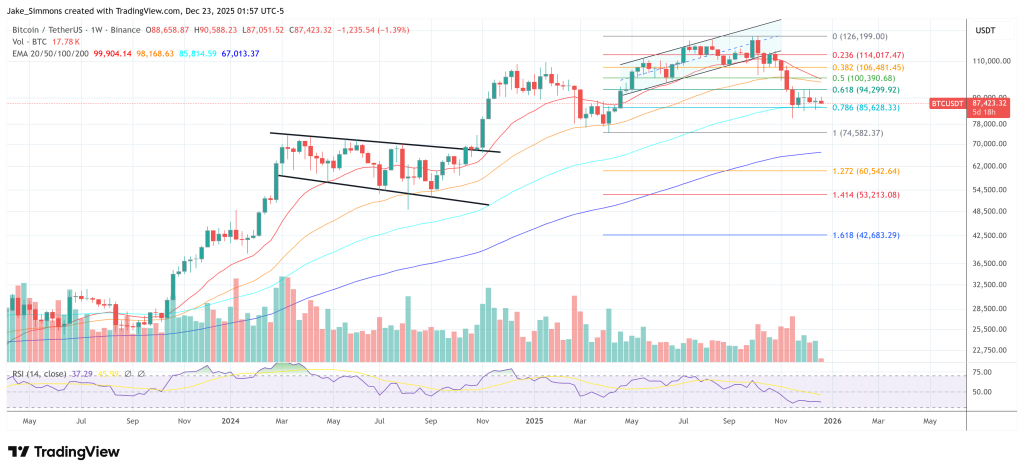
Featured picture created with DALL.E, chart on TradingView.com

modifying course of for bitcoinist is targeted on offering completely researched, correct, and unbiased content material. We adhere to strict sourcing requirements, and every web page is fastidiously reviewed by our crew of high know-how specialists and skilled editors. This course of ensures the integrity, relevance, and worth of your content material to your readers.