Among the questions you ask when evaluating an agent are slender and repeatable. Did this response keep on coverage? Is that this device name protected to approve? Does this reply match the retrieved context? Resolution fashions reply precisely that type of query. They take a structured state and a set set of allowed solutions and return a calibrated likelihood over them, relatively than free-form textual content whose confidence drifts from run to run. That makes them a robust match for the scoring step in an agent analysis, the place you desire a label and a quantity you may threshold and belief.
Amazon Bedrock AgentCore Evaluations, a functionality of Amazon Bedrock AgentCore, scores an agent via its whole lifecycle, on demand throughout improvement, in batch jobs towards saved classes, and on-line towards manufacturing visitors. Alongside 15 built-in evaluators, AgentCore Evaluations helps customized evaluators that you just outline as both an LLM-as-a-judge or a code-based evaluator. Customized LLM-as-a-judge evaluators apply your directions and score scale with a mannequin in Amazon Bedrock. Code-based evaluators run your personal logic in an AWS Lambda operate, and that logic can name your selection of exterior system, mannequin, or API, together with a choice mannequin.
Resolution fashions go well with questions with a set set of solutions that an knowledgeable individual might determine at a look, equivalent to whether or not the agent refused a request or whether or not a response stayed on subject. After you validate a query by yourself visitors, a choice mannequin will be enough for that call or rating, and you’ll lengthen the identical method to particular harmfulness or stereotyping classes in your coverage. As a result of each backends can reply a number of questions on the identical state in a single request, you should use them as a screening layer relatively than a alternative, operating a cross or fail sign throughout your metrics to pick out the turns that warrant deeper evaluation by the built-in evaluators, whose explanations assist you to examine what went fallacious.
This put up exhibits the way to join two choice mannequin backends to AgentCore Evaluations via code-based evaluators. The primary is Jev, a hosted choice mannequin from TypeSafe. The second is Strands Decider 2B, an open-source choice mannequin you run your self. By the tip of this put up, you’ll know the way to convert the AgentCore evaluator enter into a choice mannequin request, and the mannequin’s chances again into an AgentCore analysis end result. First, although, when do you have to attain for a customized LLM-as-a-judge evaluator, and when does a choice mannequin match higher? The following part breaks down what a choice mannequin is and the trade-offs concerned.
Resolution fashions
A choice mannequin is a small, specialised mannequin skilled to pick out from a set set of choices and return calibrated confidence scores relatively than producing free-form textual content. A general-purpose giant language mannequin (LLM) evaluator produces a rating with a rationale. A choice mannequin as a substitute produces a likelihood distribution over predefined solutions. That offers you a direct confidence measure you may threshold, mixture, and act on programmatically. This makes choice fashions well-suited for analysis duties the place the judgment will be said as a selection amongst a set set of choices: “Is that this response grounded?” or “Did the agent full the person’s objective?”
Resolution fashions are most helpful if you desire a well-calibrated confidence rating alongside the label, not only a binary judgment. They’re additionally acceptable if you need to implement a particular rubric persistently with out counting on a general-purpose LLM to interpret it.
Jev, the hosted choice mannequin from TypeSafe, and Strands Decider, an open-source, 2-billion-parameter choice mannequin from the Strands Brokers group, each assist three varieties of questions. A noul query poses a sure/no query and returns a likelihood between 0 (no) and 1 (sure). A selection query asks which of as much as 255 choices applies, returning probably the most possible choice together with the total distribution and a confidence. A rating query asks which of two to 10 ordered ranges applies, returning a probability-weighted rating, the distribution over ranges, and a confidence. Many analysis rubrics match certainly one of these varieties. “Is each truth on this response supported by the device outcomes?” is a sure/no query, and “How useful was this response, on a four-level rubric?” is a rating.
Resolution fashions versus LLM-as-a-judge
The built-in evaluators in AgentCore immediately use a general-purpose LLM to evaluate the agent response towards a rubric and clarify its judgment. That is invaluable when the analysis requires connecting proof, figuring out lacking info, or working via a response in depth in duties the place the reason is as helpful because the rating. Resolution fashions aren’t a alternative for LLM evaluators. They’re an addition that the code-based evaluator framework makes doable. Use them for slender, well-defined checks alongside the built-in evaluators’ broader evaluation.
Resolution overview
To indicate how these evaluator varieties work collectively, this put up builds an end-to-end instance of an HR Assistant agent evaluated by deterministic code-based checks, built-in LLM-as-a-judge evaluators, and decision-model evaluators backed by Jev or Strands Decider 2B.
The agent is constructed with Strands Brokers and deployed to AgentCore runtime, a functionality of Amazon Bedrock AgentCore. It solutions worker questions utilizing 5 instruments that return fastened mock information equivalent to paid day without work (PTO) balances, PTO requests, HR insurance policies, advantages, and pay stubs. We use fastened information on this code pattern to make it easy to confirm evaluator habits from LLM-as-a-judge and choice fashions. Whenever you moreover have floor reality, you may verify whether or not every evaluator catches the appropriate failures. This code pattern helps you arrange the framework for testing choice fashions in comparison with LLM-as-a-judge in your personal use circumstances.
Determine 1: Finish-to-end structure of the HR Assistant evaluated by code-based checks, built-in evaluators, and decision-model evaluators backed by Jev or Strands Decider
Stipulations
To deploy the pattern, you want the next:
- An AWS account in a Area the place AgentCore Evaluations is on the market. The pattern defaults to US West (Oregon).
- Amazon CloudWatch Transaction Search enabled within the account.
- Entry to a basis mannequin in Amazon Bedrock.
- Python 3.12 or later, the AWS Command Line Interface (AWS CLI), and Docker.
- Jev requires a TypeSafe API key. Go to typesafe.ai for entry particulars.
- Strands Decider requires a bunch operating the Strands Decider server. You’ll be able to run it domestically for testing, or on Amazon Elastic Compute Cloud (Amazon EC2) inside your digital personal cloud (VPC) so the Lambda operate can attain it.
Seeing it in motion
You could find the total code pattern within the AgentCore samples GitHub repository. Two Python scripts deal with all the pieces:
../utils/deploy.pydeploys the HR Assistant to AgentCore runtime.consider.pydeploys evaluators, invokes the agent, and runs the analysis modes.
Operating consider.py with out flags executes 5 steps:
- Creates the Lambda execution function (
AgentCoreLambdaEvaluatorRole). - Packages and deploys two deterministic Lambda evaluators:
hr-response-length(a trace-level evaluator that checks whether or not the agent’s response stays inside size bounds) andhr-fact-checker(a session-level evaluator that regex-validates HR info towards the identified mock information). - Registers each as AgentCore code-based evaluators via the management airplane.
- Runs on-demand analysis with
EvaluationClientandOnDemandEvaluationDatasetRunnerthroughout 5 labeled situations, combining the code-based evaluators withBuiltin.Correctness,Builtin.Helpfulness, andBuiltin.ResponseRelevance. - Creates a web-based analysis configuration that repeatedly scores stay classes at one hundred pc sampling.
At this level you’ve a working analysis pipeline with deterministic checks and LLM-as-a-judge scoring. Resolution-model evaluators are opt-in. You’ll be able to add them with a flag, and so they run alongside the bottom evaluators with no modifications to the present stream. Utilizing the flags --with-jev --jev-secret-arn <ARN> deploys jev-evaluator and registers three evaluators: JevGroundedness, JevHelpfulness, and JevGoalCompletion. Utilizing the flag --with-decider deploys strands-decider-evaluator and registers the identical three evaluators backed by Strands Decider 2B. Add --decider-ec2 to auto-provision the Amazon EC2 occasion, safety teams, IAM function, and Lambda VPC configuration with out handbook console steps.
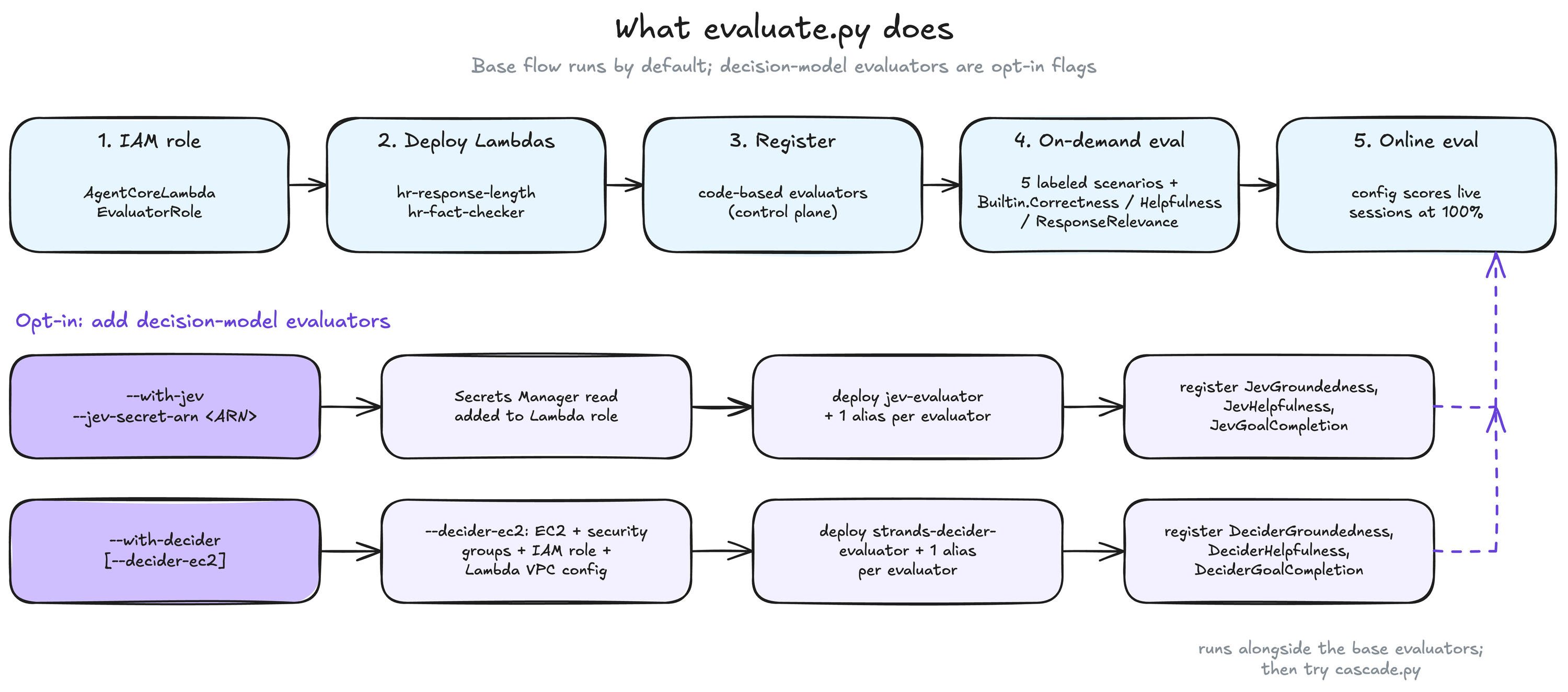
Determine 2: The analysis pipeline deployed by consider.py, from deterministic checks via built-in and decision-model evaluators
Every decision-model backend contributes three evaluators:
| Evaluator | Degree | Query kind | Label | Worth |
| JevGroundedness / DeciderGroundedness | TRACE | noul |
Grounded or Ungrounded | P(grounded) |
| JevHelpfulness / DeciderHelpfulness | TRACE | rating (4-level) |
Most possible degree | Anticipated degree, scaled 0–1 |
| JevGoalCompletion / DeciderGoalCompletion | SESSION | selection (3-way) |
Most possible choice | Chance-weighted worth |
Construct the evaluator with choice fashions
Utilizing the flags --with-jev and --with-decider creates a customized code-based evaluator, the place you’ve full management of the code you need to run as your evaluator. We create AWS Lambda capabilities the place the choice mannequin is invoked inside an AWS Lambda operate and returns a label or a numeric worth. This Lambda operate is registered because the code-based evaluator in AgentCore Evaluations.
The Lambda that’s registered because the evaluator receives OpenTelemetry spans of the agent. The spans.py module normalizes the shapes OpenTelemetry content material can arrive in after which codecs it appropriately to make the decision to the choice mannequin. For trace-level analysis, solely the focused flip and transient prior historical past are despatched, whereas the total dialog is included for session-level.
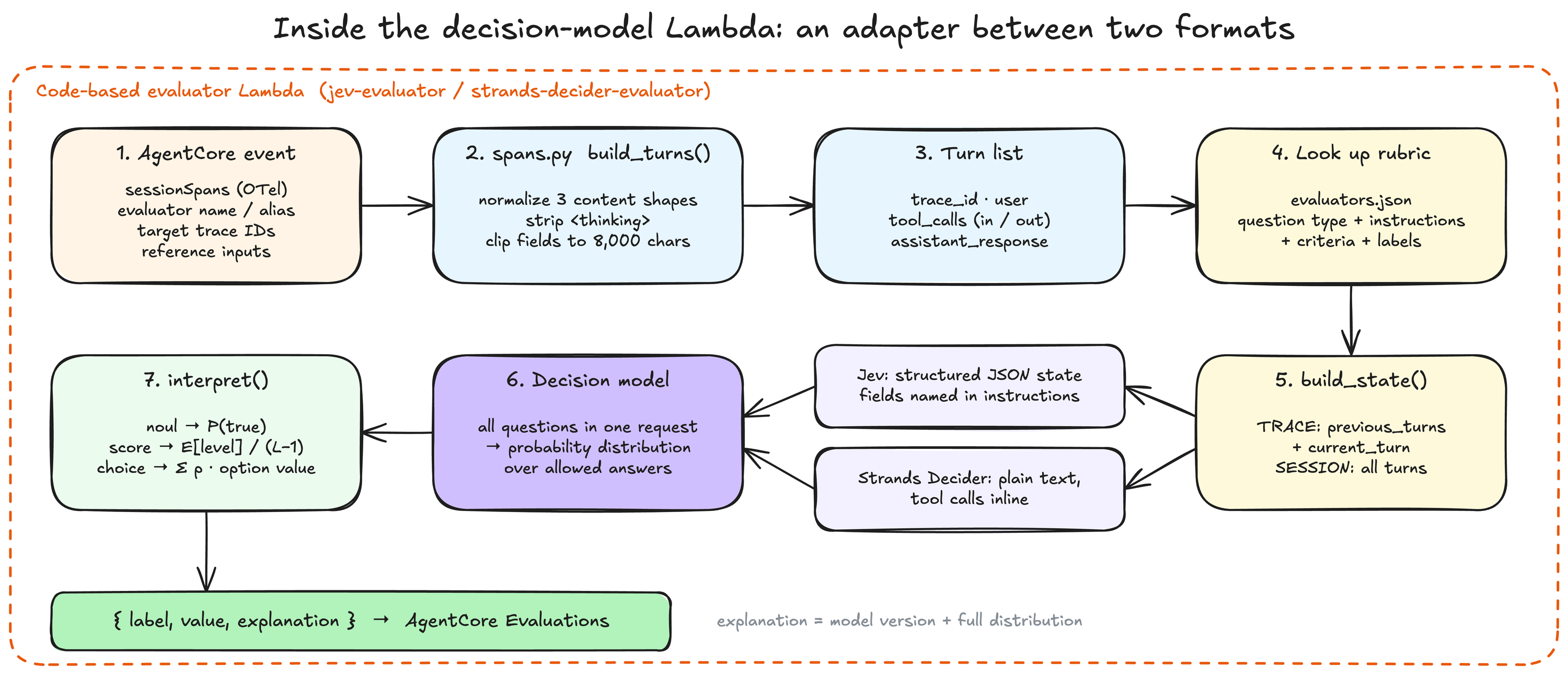
Determine 3: How the code-based evaluator Lambda adapts OpenTelemetry spans for the choice mannequin and maps the end result again to AgentCore
The adapter converts the mannequin’s likelihood distribution right into a end result that AgentCore analysis expects. For a noul query, the likelihood of true turns into the worth and probably the most possible reply turns into the label. For a rating query, the worth is the probability-weighted anticipated degree scaled to [0, 1]. For a selection query, it’s the weighted common of predefined choice values.
Validate a decision-model evaluator by yourself visitors
Whenever you rewrite a rubric as a choice mannequin query, you’ve created a brand new measurement relatively than a replica of the previous one. A reframed rubric usually lands stricter or looser than the unique supposed, and also you gained’t see that drift till you test it towards actual classes. Earlier than you gate a launch on a decision-model evaluator, validate it the identical manner you’d validate any new measurement, towards a labeled pattern of your personal visitors. The objective of this part is to stroll you thru that validation finish to finish, so that you end with an evaluator you may threshold with confidence.
The process has 5 steps.
Step 1. Construct a labeled pattern. Pull a set of saved classes out of your agent’s visitors, with sufficient protection of the failures and edge circumstances you care about. A pattern that covers solely the completely happy path tells you nothing about the place the evaluator breaks.
Step 2. Get human reference labels. Have three impartial labelers rating every flip for the property your query measures and take the bulk vote because the reference label. Hold monitor of which turns have been unanimous and which have been cut up. Though unanimous turns are the clear-cut circumstances, the split-vote turns are the precious ones, as a result of they reveal ambiguity within the rubric itself earlier than the mannequin ever sees it.
Step 3. Run each evaluators on the identical inputs. Run the decision-model evaluator and the matching built-in evaluator over those self same classes in a single batch analysis. Scoring equivalent inputs is what makes the comparability apples to apples.
Step 4. Learn the outcomes via three lenses. With the majority-vote labels and the straightforward and onerous cut up in hand, now you can reply the three questions that inform you whether or not the evaluator is prepared.
- Settlement fee: does it match your people? Measure how usually every evaluator agrees with the majority-vote labels, and do it per query, since one query’s accuracy says nothing about one other’s. Then break the numbers out by straightforward (unanimous) and onerous (split-vote) circumstances. An evaluator that stumbles solely on the onerous circumstances is behaving loads like your human labelers did, which is strictly what you need.
- Calibration: do the arrogance scores imply one thing? Group turns by the evaluator’s reported likelihood and evaluate every group’s settlement with the labels. Larger confidence ought to monitor larger accuracy. Then test whether or not straightforward circumstances persistently draw larger confidence than onerous ones. In the event that they do, the mannequin’s uncertainty is monitoring real ambiguity, and you should use these teams to choose a choice threshold per evaluator as a substitute of defaulting to 0.5.
- Disagreement evaluation: the place and why do they differ? Discover the turns the place the 2 evaluators disagree with one another, and test whether or not these are the identical turns your people discovered ambiguous. Learn them. Most disagreements hint again to the wording of the query, and a revised query clears them up. When the errors cluster within the onerous circumstances, the rubric is the issue relatively than the mannequin.
Step 5. Re-run the test when something modifications. Deal with this as a repeatable test relatively than a one-time gate. Any time you reword a query or transfer to a brand new mannequin model, run it once more. Every end result’s rationalization information the mannequin model that produced it, so which model a given rating got here from.
Selecting the most effective set of evaluators in your agent
The built-in evaluators stay the muse of broad analysis technique in AgentCore Evaluations. They assess the response towards a rubric and its supporting context, and clarify the judgment so builders can examine what went fallacious. For the HR Assistant, a faithfulness analysis can establish a declare that contradicts a device end result, whereas a helpfulness analysis can level out that the agent answered a steadiness query however left a requested motion incomplete.
Faithfulness, helpfulness, and correctness can require connecting proof, figuring out lacking info, or working via an answer. The preprint JEV-as-a-Decide: Settle for When Assured, Escalate When Not sure describes a associated distinction as “studying versus deriving.” A slender decision-model test can flag a flip for consideration, whereas the built-in evaluator supplies the broader evaluation and reasoning wanted to overview it. Resolution fashions shine brightest if you deal with them as a gate relatively than a alternative. The cascade sample works like this. First, run a quick, calibrated choice mannequin on each flip of each session to get an inexpensive cross/fail sign. Then invoke a full LLM evaluator solely on classes the place the sign falls under your threshold.
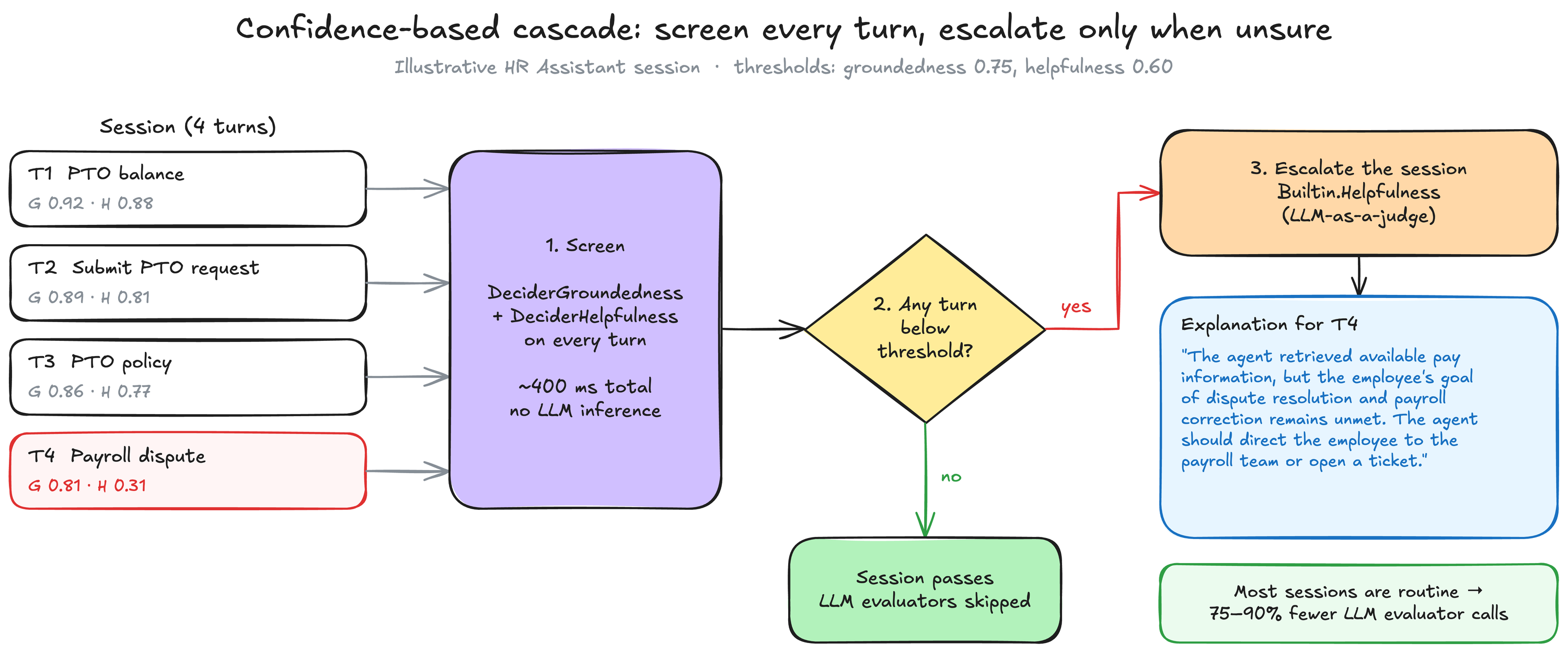
Determine 4: The cascade sample, the place a calibrated choice mannequin screens each flip and solely low-confidence turns escalate to a built-in evaluator
| Criterion | LLM as Decide | Resolution Fashions as Decide |
| Output | Rating + rationalization | Calibrated likelihood |
| Latency | 2–10 s | ~a whole bunch of ms (community) |
| Customizable | Restricted (fastened immediate templates) | Query definitions |
| Greatest for | Qualitative nuance, rationalization | Calibrated judgment |
We suggest the next setup:
- Configure on-line analysis with the built-in evaluators you depend on, as the usual measure of high quality throughout your brokers.
- Add decision-model evaluators for domain-specific sure/no and selection inquiries to the identical configuration, together with deterministic code-based evaluators for something you may compute precisely.
- Every week, or on no matter schedule fits your launch cycle, question the net outcomes for classes the place a decision-model test failed or scored close to its threshold, and run batch evaluations on these classes with the built-in evaluators to get explanations.
- Gate releases on the built-in evaluators and on the decision-model evaluators you’ve validated towards labeled information, and monitor how usually the 2 agree.
Clear up
To keep away from ongoing costs, run the cleanup.py that deletes the agent hosted on AgentCore runtime, the evaluators and analysis config, the AWS Lambda capabilities which are registered because the evaluators, the EC2 occasion that hosts the Strands Decider mannequin, AWS Secrets and techniques Supervisor key and the related log group on CloudWatch.
Conclusion
On this put up, you related two choice fashions, Jev and Strands Decider, to AgentCore Evaluations utilizing code-based evaluators, and the accompanying code pattern provides you a framework for testing these fashions and seeing the place they add worth as evaluators. The built-in evaluators stay your baseline. Resolution fashions add slender, validated checks that include a measure of certainty you may threshold and act on. The sensible path ahead is so as to add decision-model checks alongside the built-in evaluators you already run, measure how usually they agree along with your reference labels by yourself visitors, and develop protection solely when you belief them.
To get began, overview the Amazon Bedrock AgentCore Evaluations documentation, combine customized evaluators utilizing code-based evaluators and take a deeper look into Strands Decider mannequin. Get began with code samples by deploying the pattern evaluators from the Amazon Bedrock AgentCore sample repository.
In regards to the authors