Whole addressable market (TAM) is an estimation of how a lot you can earn for those who may promote your services or products to each attainable buyer in your market.
The fundamental components for calculating TAM is:
TAM = (Whole Variety of Potential Prospects) × (Common Annual Income per Buyer)Understanding TAM helps you determine the scale of your market and the sum of money you can make for those who captured all of it.
TAM can also be a key metric for startup buyers. It exhibits whether or not a enterprise concept has a large enough alternative. Traders usually search for a TAM that’s “good” — not too massive or too small. A TAM that’s too giant may imply the market is crowded with powerful competitors, whereas a TAM that’s too small may imply restricted room for development.
On this information, you’ll learn to estimate TAM utilizing three strategies, the place individuals usually make errors, and refine your estimations to make them believable to buyers or stakeholders and actionable for your enterprise.
There are three approaches to calculating TAM. Relying on the obtainable market knowledge, your enterprise mannequin, and your stakeholders/buyers, you must think about using the top-down, bottom-up, or worth idea method.
1. High-down method
The highest-down method begins with broad market knowledge and narrows it right down to estimate the market dimension to your particular services or products.
This method is helpful when there’s dependable, broad trade knowledge obtainable.
Easy methods to use
- Estimate the general market dimension by which your product operates, often obtained from trade stories or analysis.
- Apply a share that represents the portion of the market your product can realistically seize.
Instance
If the worldwide smartphone market is valued at $500 billion, and you’re launching a brand new smartphone accent, you may estimate that your product may goal 5% of the market, which provides you a TAM of $25 billion.
2. Backside-up method
The underside-up method builds the TAM by beginning with particular, particular person knowledge associated to your enterprise and scaling it up.
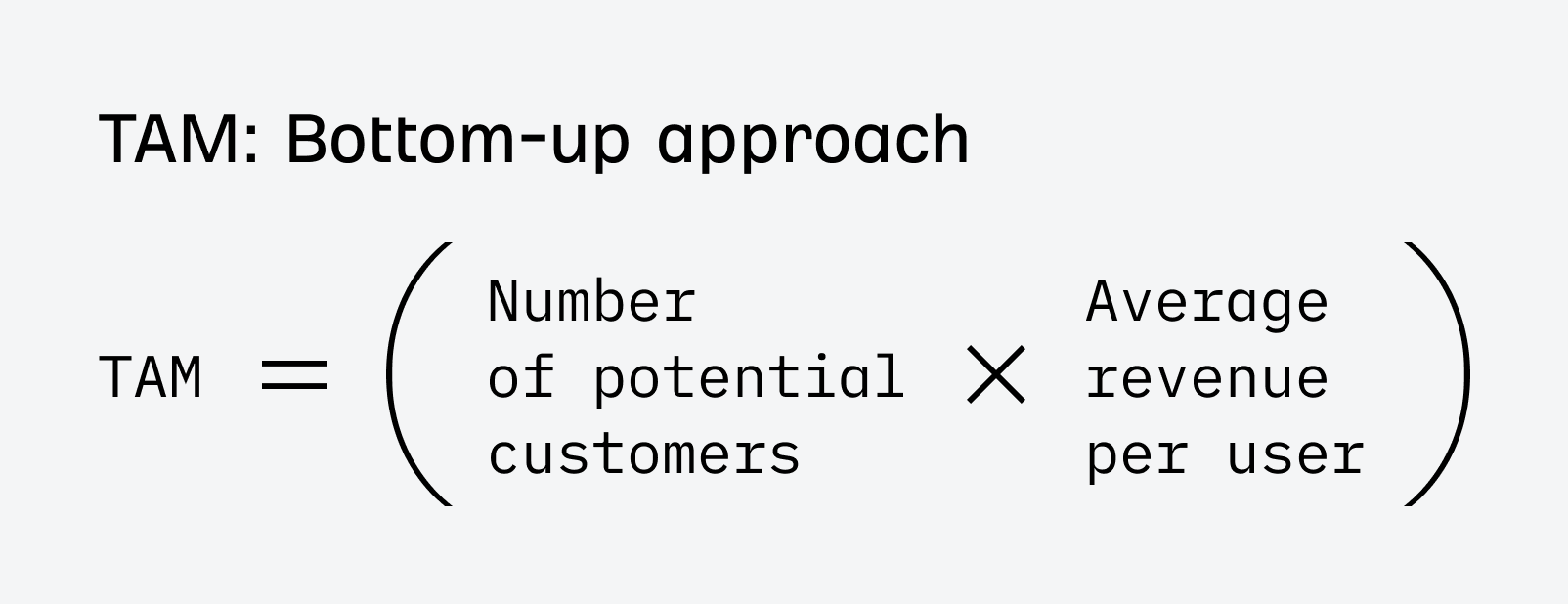
This technique is nice when you could have detailed data of your buyer base and pricing. So far as I do know, buyers choose this technique, which presents essentially the most correct and actionable TAM estimation.
Just a few birds within the hand is value billions within the TAM. Early-stage (pre-Sequence-B) startups shouldn’t fear an excessive amount of about calculating a exact TAM. So long as it’s in the precise ballpark for his or her thesis, buyers care much more concerning the traction you possibly can present with paying prospects. That’s why bottom-up is much extra convincing than hand-wavy top-down strategies that solely depend on discovering a large enough pie to assert as your market.

Easy methods to use
- Estimate what number of potential prospects there are in your goal market. You are able to do this by utilizing sources like trade stories, census knowledge, or analysis from trusted organizations (extra knowledge sources on the finish of the article).
- Multiply this quantity by the typical income you anticipate to earn from every buyer (ARPU – Common Income Per Consumer).
Tip
To calculate ARPU, contemplate the pricing of your services or products, how ceaselessly prospects will buy, and the churn charge.
For instance, for those who cost $100 monthly for a subscription service, your month-to-month churn charge is 5%; on common, a buyer may keep subscribed for round 6-7 months, that means your common income per buyer could be round $600-700.
Instance
Let’s say you could have subscription-based software program that helps small companies handle their funds. You determine that 2 million small companies may benefit out of your software program. In case your ARPU is $600, your TAM could be 2 million prospects × $600 = $1.2 billion.
3. Worth idea method
The worth idea method estimates TAM based mostly on the worth your product gives to prospects and the way a lot they is likely to be prepared to pay for it.
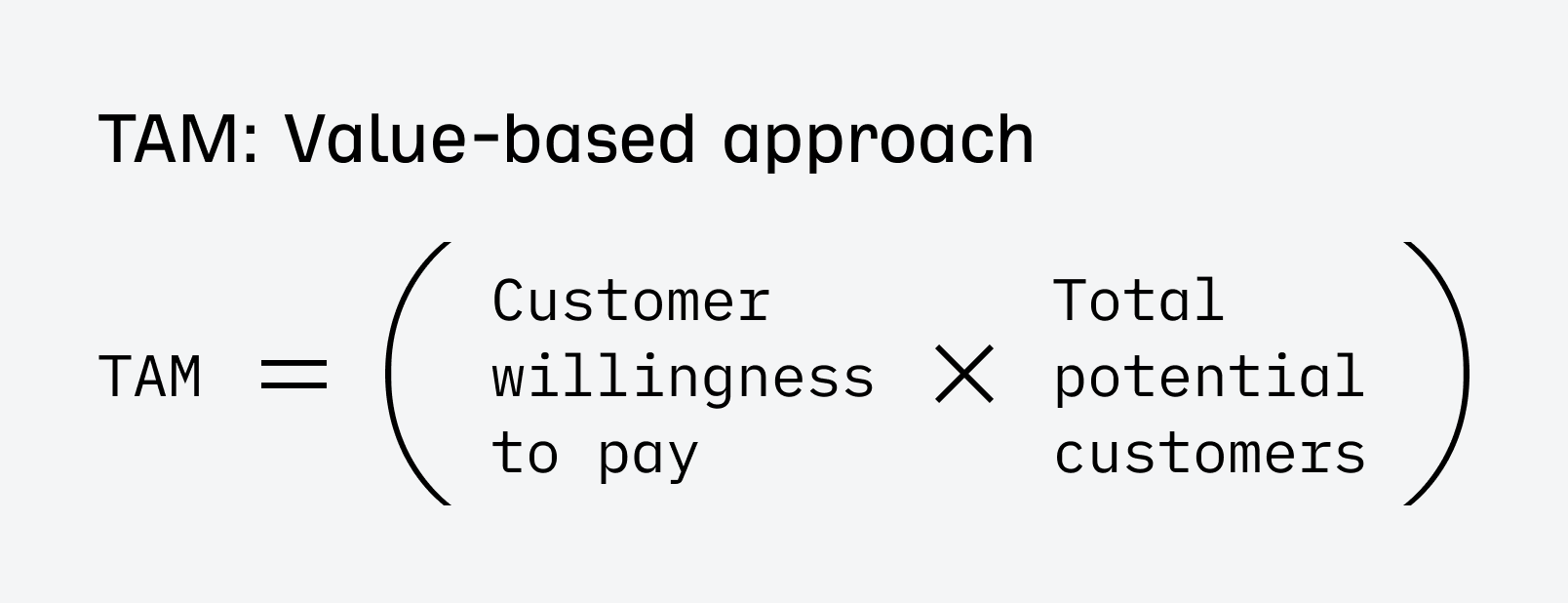
This method is particularly helpful for those who’re introducing a services or products that disrupts current markets; conventional market dimension calculations might not precisely replicate the potential.
Easy methods to use
- Assess the worth or price financial savings that your product delivers to the client.
- Estimate how a lot prospects could be prepared to pay for that worth and scale it throughout all the market.
Instance
Suppose you could have developed a brand new energy-efficient lighting system that saves firms $10,000 per 12 months in vitality prices.
If 100,000 firms may use your lighting system, and every is prepared to pay $5,000 for it (as a result of they’ll save $10,000), your TAM could be 100,000 firms × $5,000 = $500 million.
There’s additionally a fourth possibility — a center floor talked about by fairly a couple of individuals who supplied their insights for this text.
I’d say the perfect technique to estimate TAM is often a mix of top-down and bottom-up approaches. The highest-down technique offers you an enormous image view utilizing trade stories and market analysis, whereas bottom-up permits you to construct from the bottom up utilizing your individual knowledge and buyer insights. This mixed method helps stability out the weaknesses of every technique.

Chances are you’ll encounter the TAM, SAM, and SOM terminology and wish to use it if an investor requests it.
Individuals who choose this method deal with TAM as a “pie within the sky” quantity and additional refine it with SAM and SOM parts of it.
- TAM (Whole Addressable Market) is the full market for those who may promote to everybody, all over the place. Your greatest attainable alternative.
- SAM (Service Addressable Market) is the portion of the TAM you possibly can truly goal based mostly on the place you use and who your product is for. For instance, for those who’re a neighborhood espresso store in New York Metropolis, your SAM is likely to be espresso drinkers in NYC, not each espresso drinker worldwide.
- SOM (Service Obtainable Market) is the sensible piece of the SAM that you could truly win over, contemplating the competitors and your strengths. Persevering with with the espresso store instance, your SOM is likely to be the variety of prospects you possibly can realistically entice in your neighborhood, given elements like close by rivals, your distinctive choices, and advertising efforts.
TAM is often used to make a compelling story concerning the potential for development, so it’s simple to be over-optimistic and make errors that might make your TAM look higher.
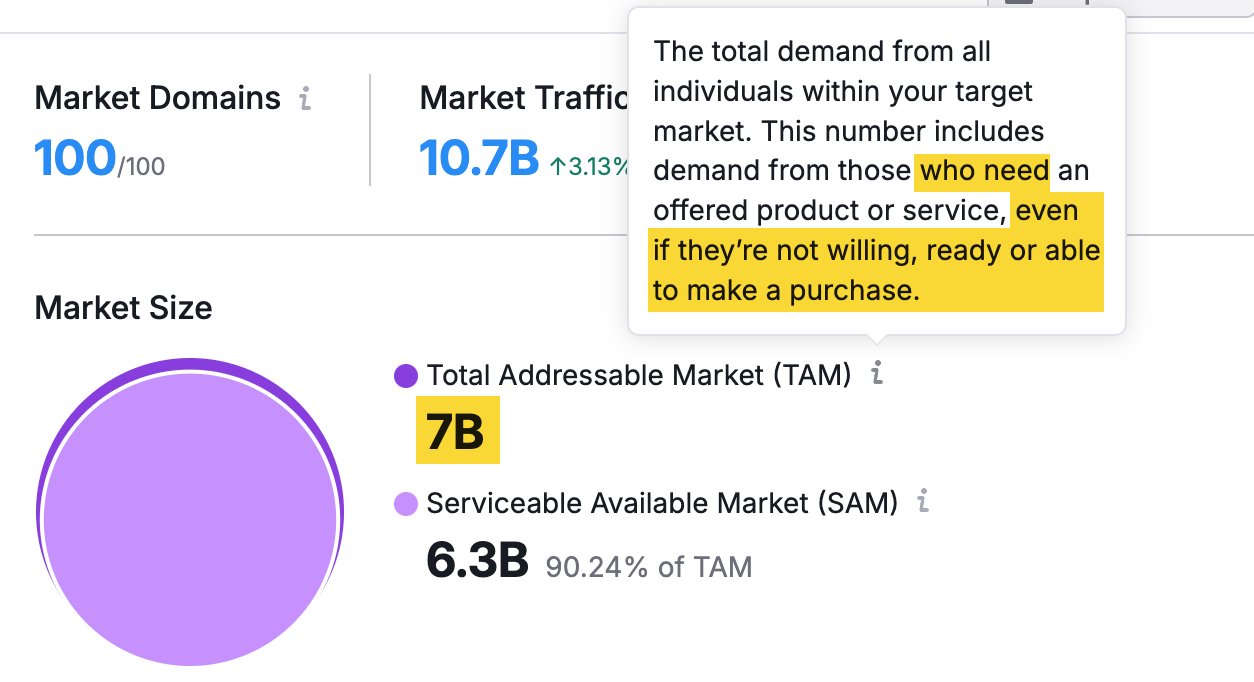
Right here’s an instance. I used a instrument that calculates TAM routinely based mostly on a URL to search out the market dimension for netflix.com. The instrument instructed me that there are 7B individuals who “want it (…) even when they’re not prepared or in a position to make a purchase order” and 6.3B able to make a purchase order. One thing that I discover laborious to consider since there are an estimated 5.3B individuals with web entry worldwide.
Additionally, the way in which that the instrument defines my potential prospects doesn’t sound convincing to me, both, not to mention logical.
Different errors you must keep away from:
- Falling into the “all the things entice”. That is when companies assume that their services or products may enchantment to everybody available in the market, main them to calculate TAM based mostly on a very broad viewers.
- Sizing the issue as a substitute of the market. This occurs when companies deal with the full quantity of people that may profit from their answer with out contemplating what number of are realistically prepared to pay for it.
- Overlooking market tendencies and dynamics. The market can develop or contract, shopper preferences can change, authorities laws can affect the market, and so forth.
The fundamental knowledge sources for TAM calculations are trade stories you will discover on platforms like Statista and census knowledge (just like the US census data). Nevertheless, there are different locations the place you possibly can search for extra detailed knowledge.
Discover the market utilizing search knowledge
Search knowledge is details about what individuals are searching for on-line. It could possibly allow you to perceive what prospects need, the place curiosity is rising, and what areas are most energetic.
Google Traits gives a few of that knowledge without spending a dime. For instance, you possibly can verify if curiosity in a plant-based eating regimen continues to be robust and the place within the US you can discover essentially the most prospects.
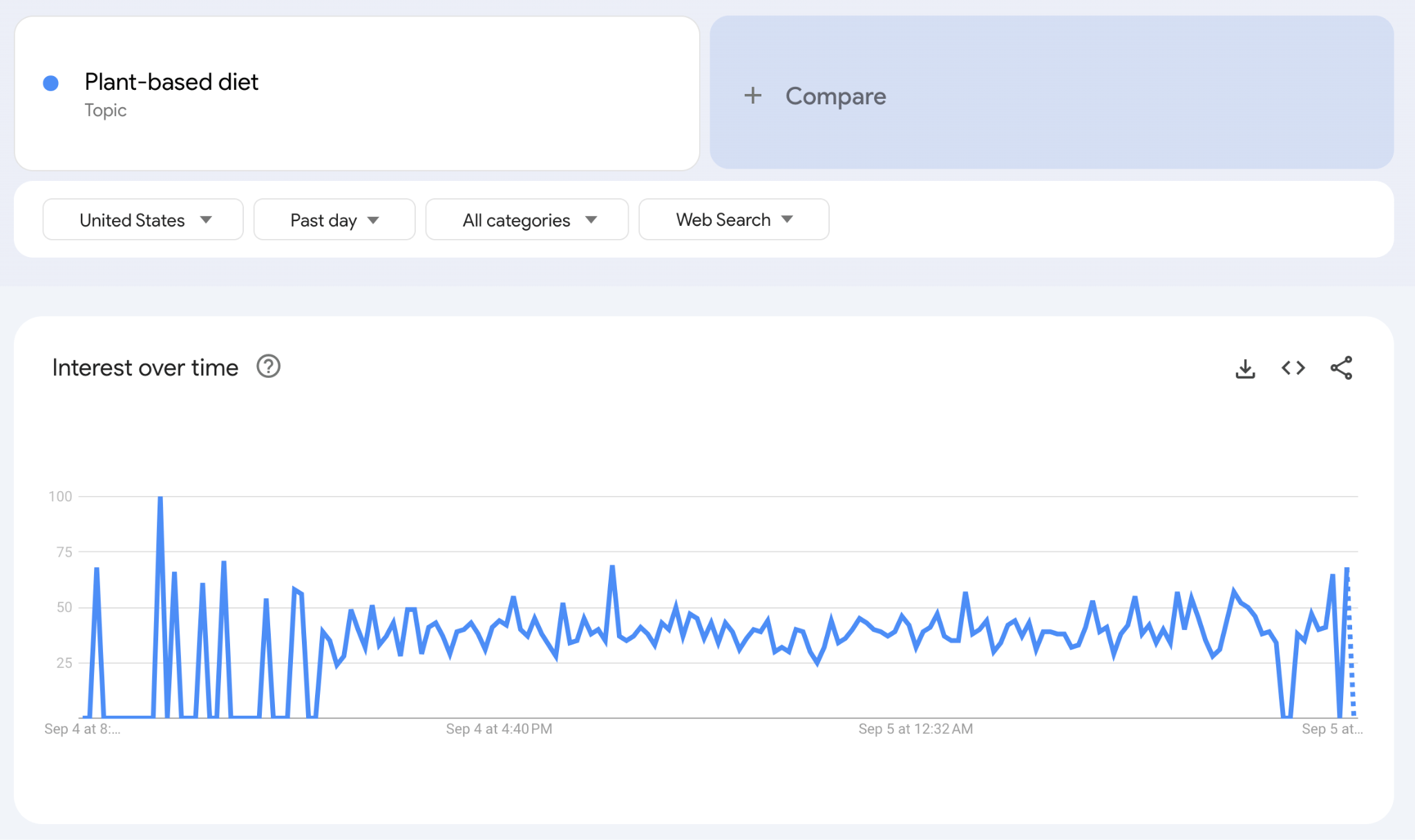
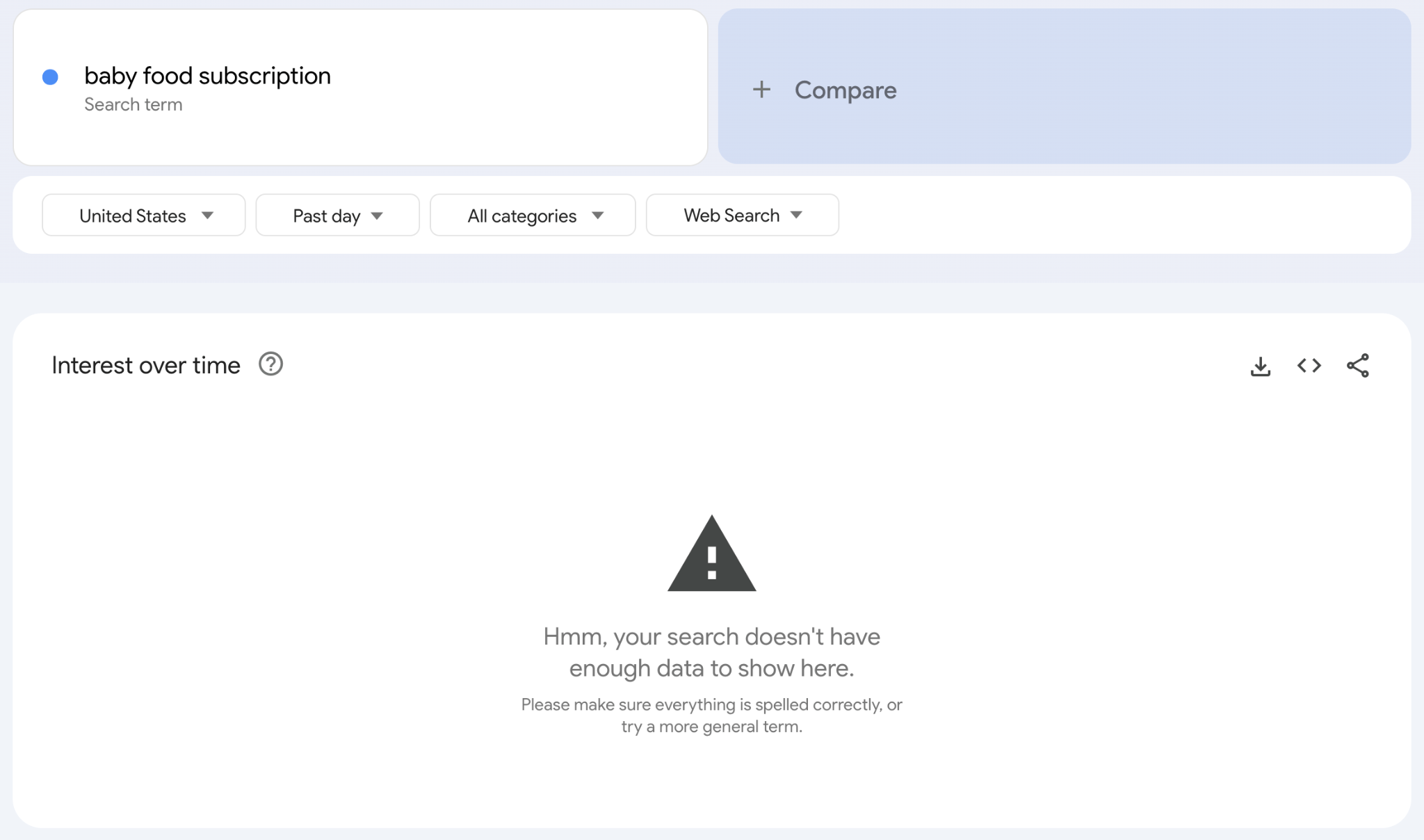
However that’s how far this instrument goes. You don’t know what phrases are “inside” the subject or how widespread a key phrase is (the numbers in Google Traits are relative). Additionally, generally Google gained’t have the information, identical to for the time period “child meals subscription”.
Alternatively, you should use Ahrefs. I’m certain you’ll discover extra search phrases there and much more knowledge factors. Let me take you thru three examples.
Gauge demand with search quantity
Search quantity is an estimation of the typical month-to-month variety of searches for a key phrase over the newest identified 12 months of knowledge.
Excessive search volumes recommend a bigger potential market. Low search volumes, recommend a smaller market (or that you’ll want to be extra inventive to search out prospects).
For instance, whereas Google Traits didn’t have any knowledge on “child meals subscription”, Ahrefs’ Keywords Explorer shows that there are an estimated 1.2K searches per month in the US of that term. Plus, it shows you the forecast for that keyword.
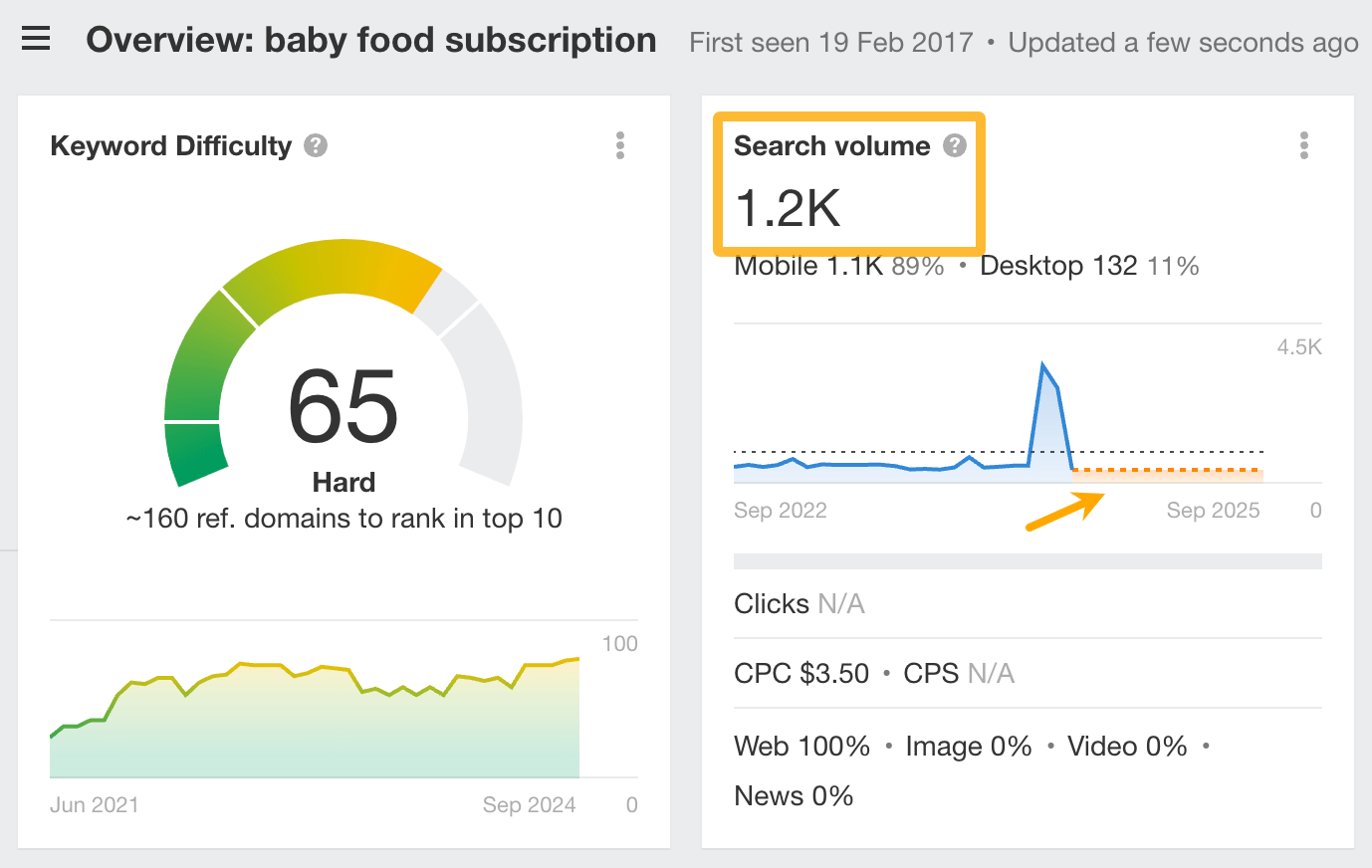
If you’d be planning to start a new business in this niche, you’d need compelling arguments to justify a high TAM estimate, because the current demand for this type of service appears to be relatively low.
Learn what people want and how they look for it
For example, for plant-based products, you could just type in “plant-based, vegan” and then go to the Matching terms report to see the popularity of certain types of products. You can also see if the demand for these products has grown or fallen over the last three months.
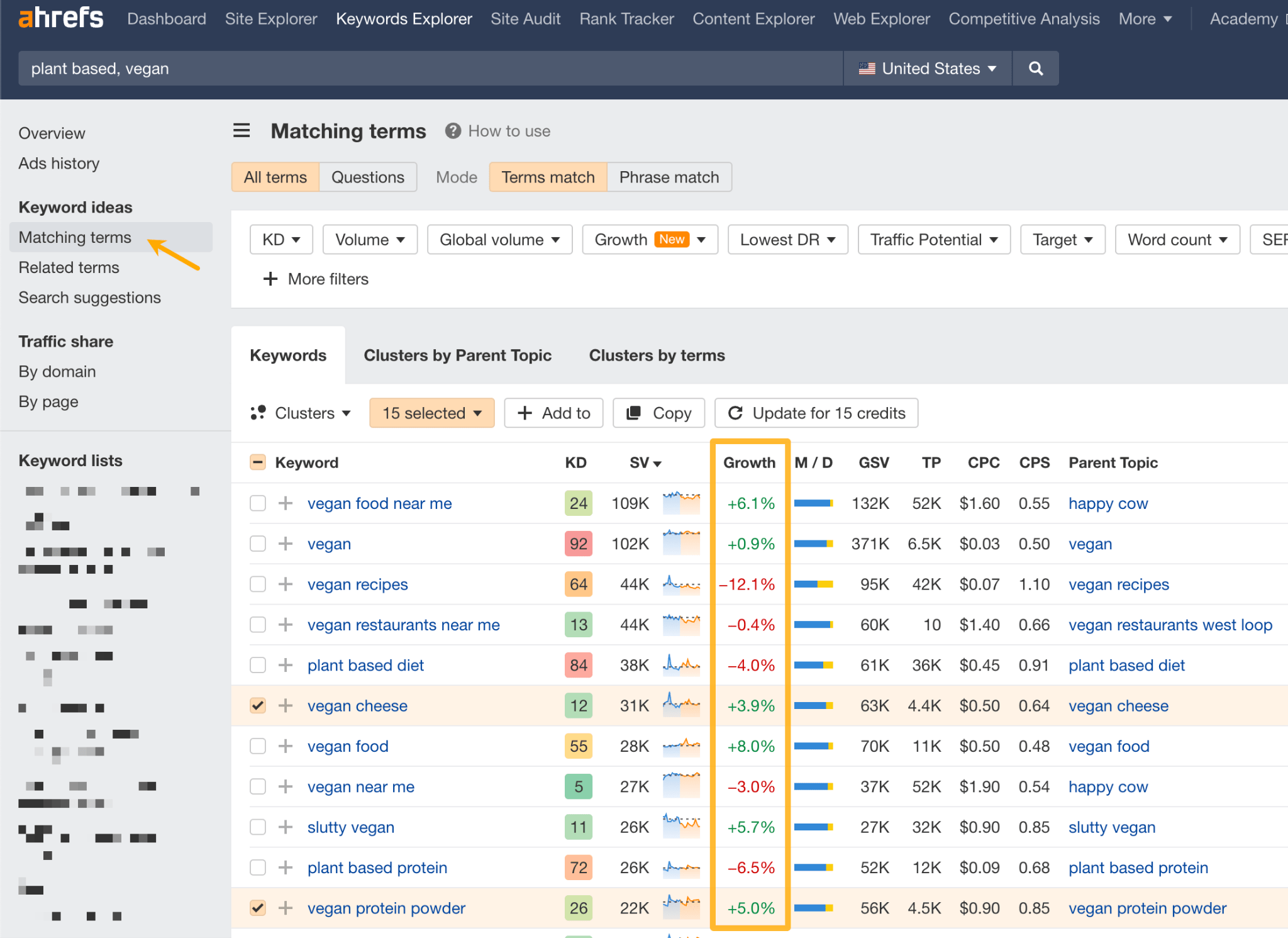
So, if you find that the demand for most vegan products has increased, you could assume that your TAM is going to expand in the near future because more people seem to be interested.
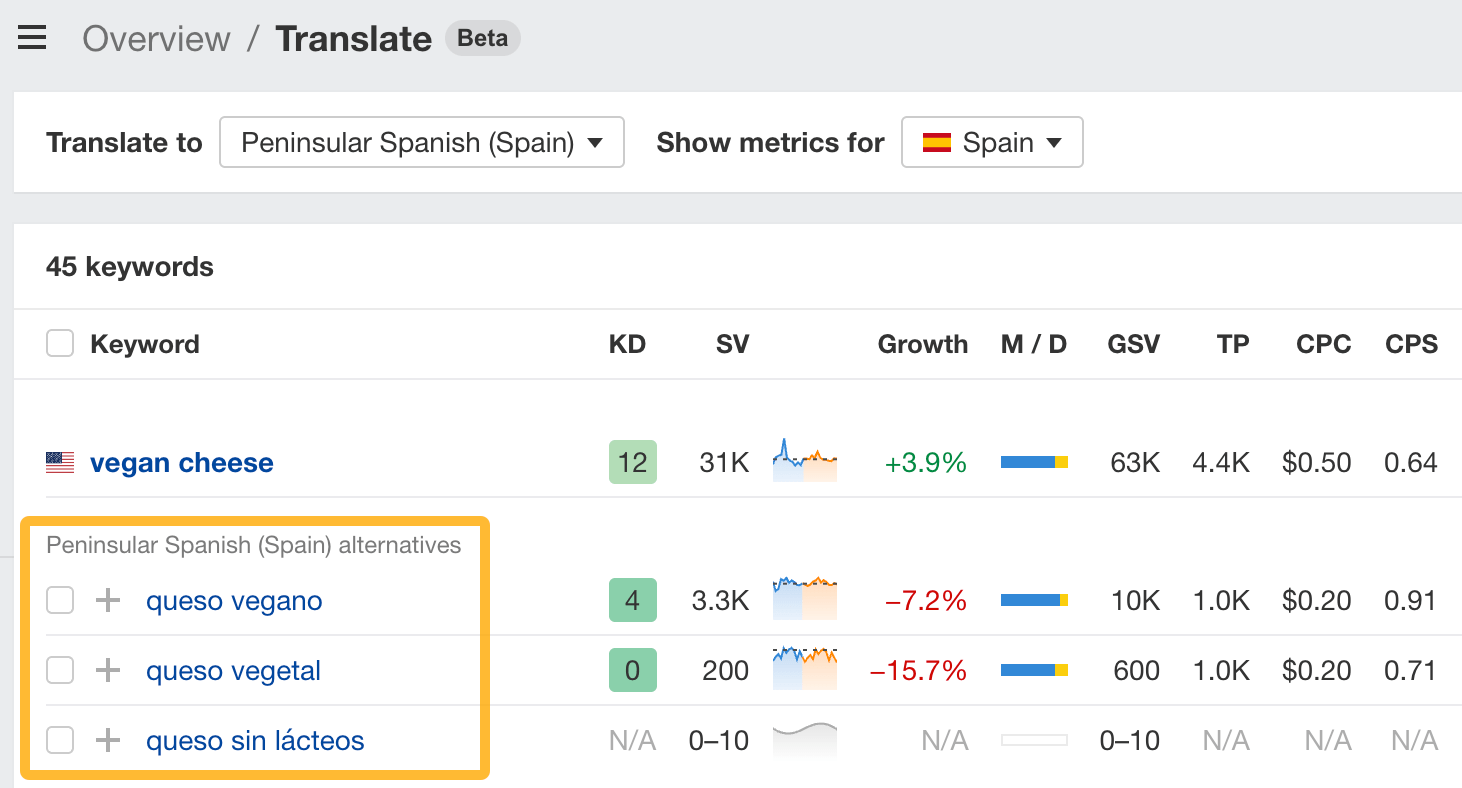
You can also use the tool to automatically translate these keywords and see what search terms people use to find the same products around the world and how popular they are.
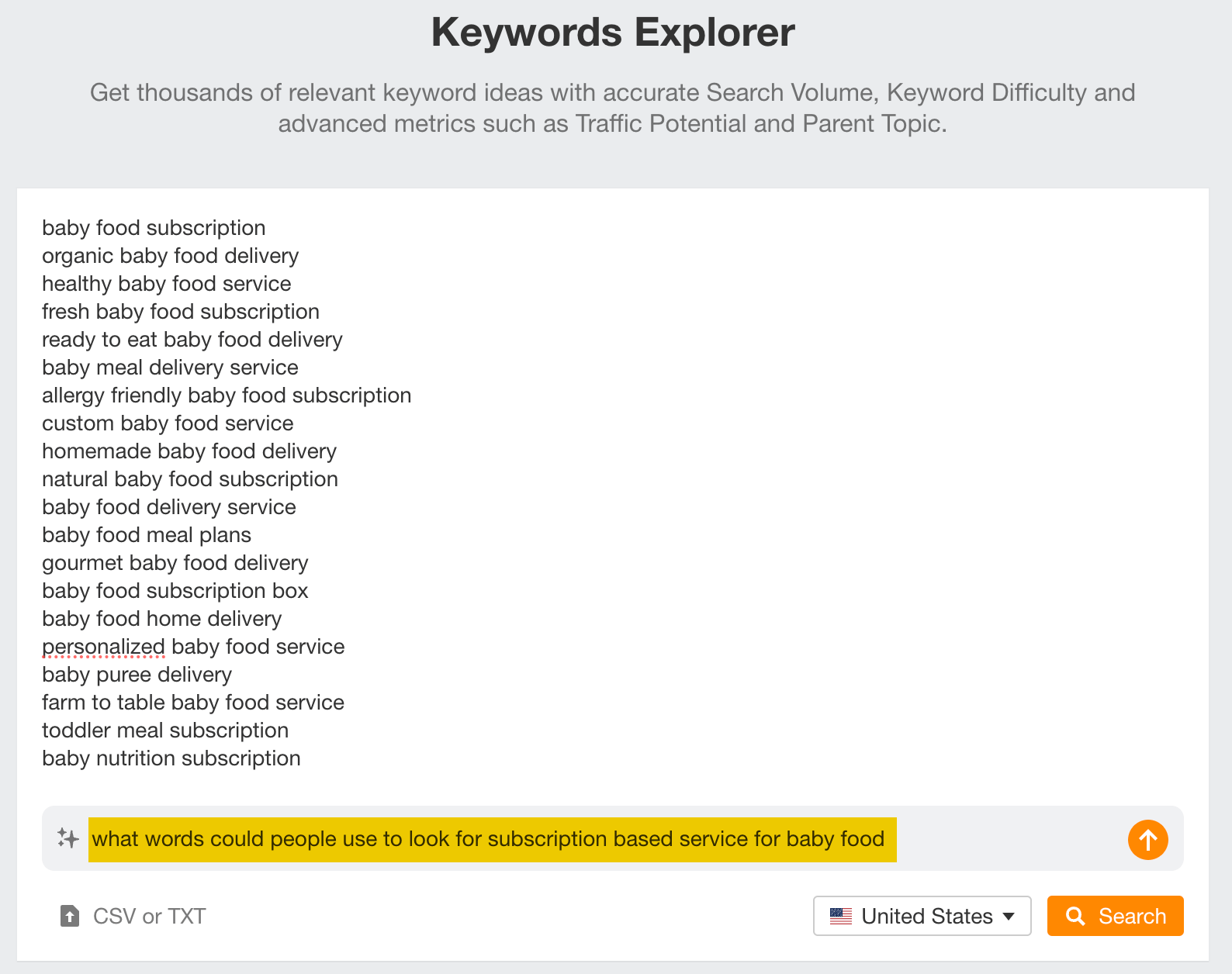
And if you’re unsure what keywords people could use to find a product or service like yours, just use the AI suggestion feature.
Learn from your competitors
By studying the keywords your competitors are targeting, you can uncover untapped niches or areas where demand is high but competition is lower.
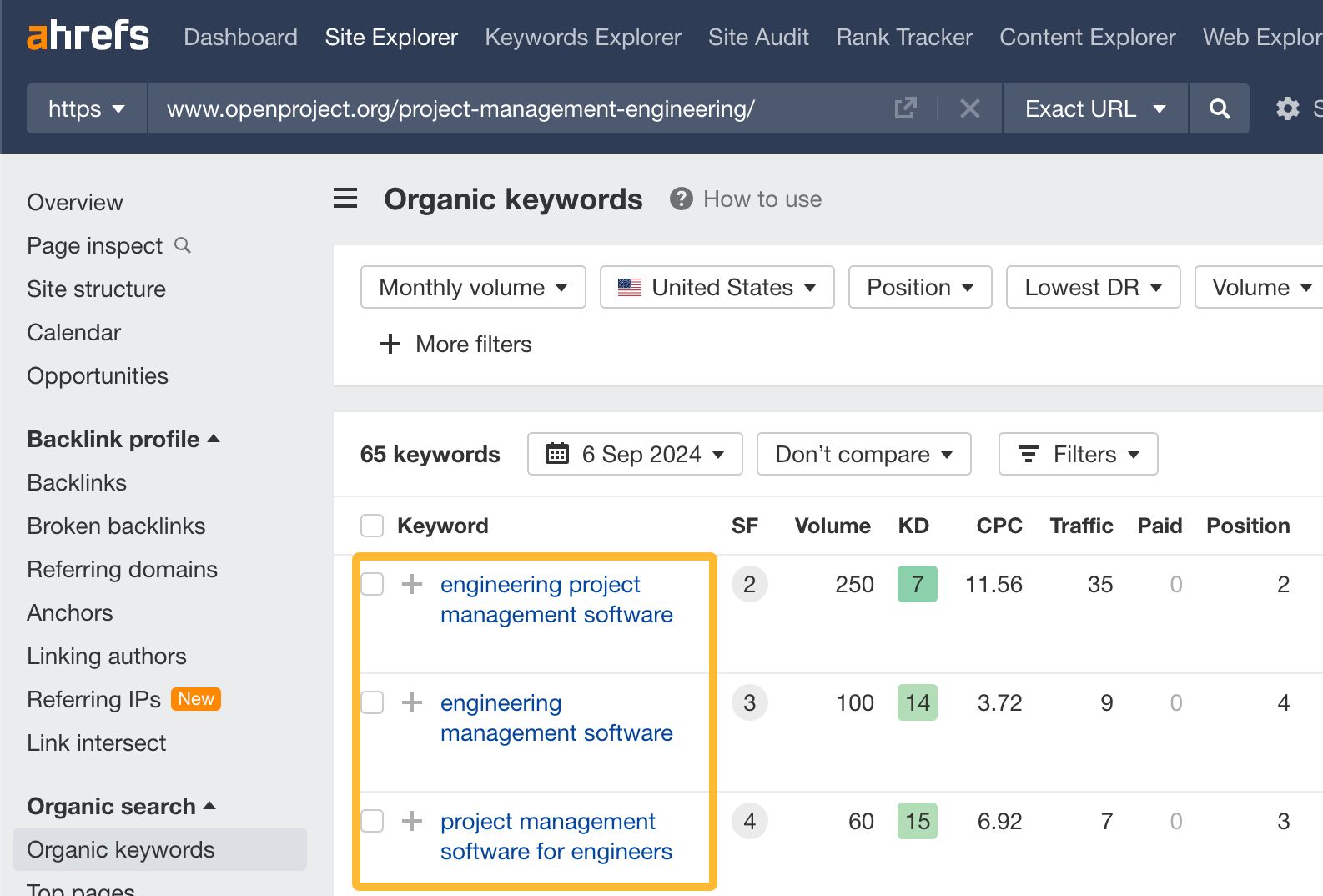
For example, say you’re a SaaS company offering a project management tool. If you used Ahrefs’ Site Explorer, you would find that one of your competitors ranks for terms like “engineering project management software”. This could indicate a niche market with unique needs, where there’s considerable demand but less competition.
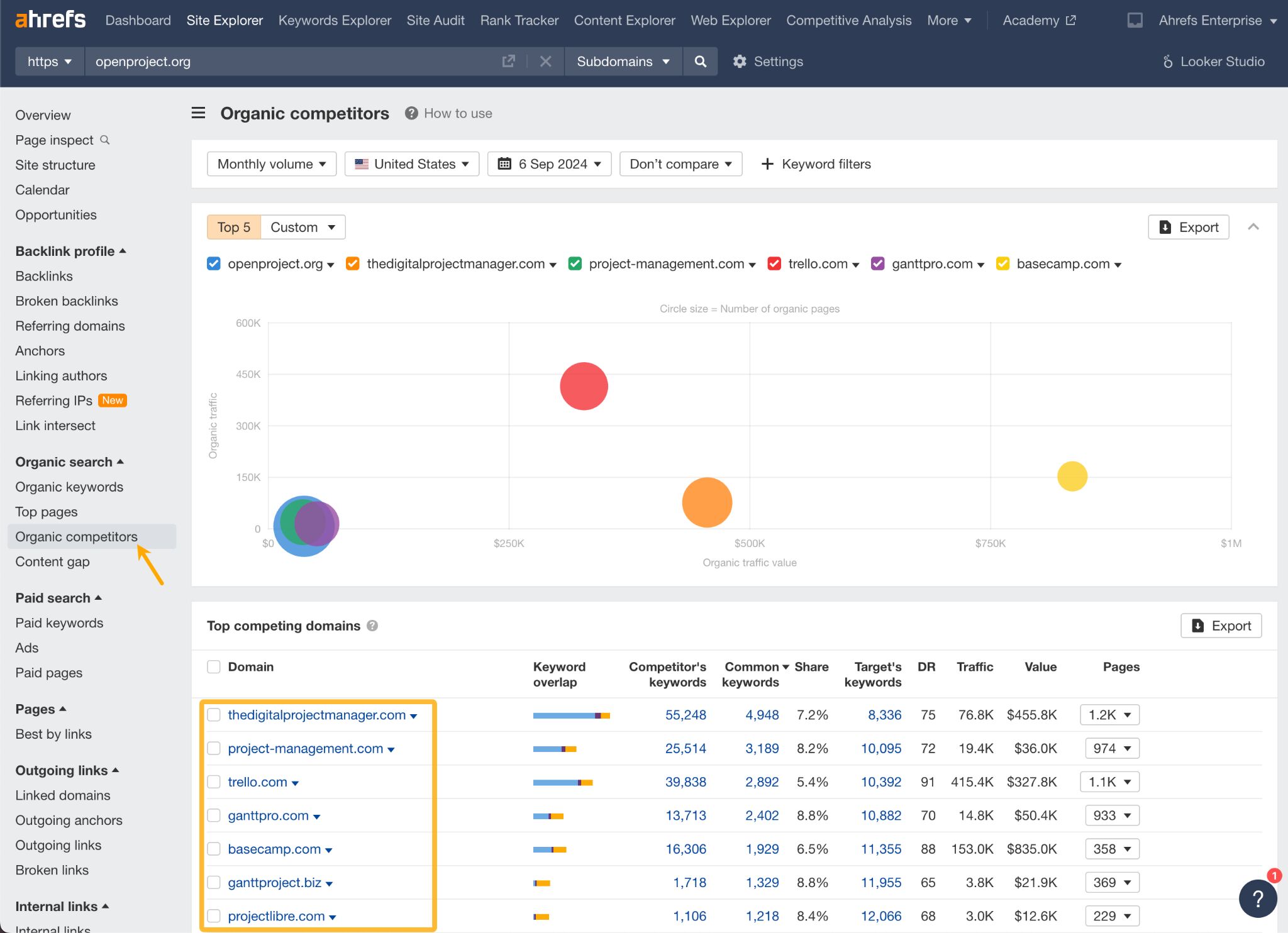
While you’re at it, go to the Organic Competitors tab to see who else competes for the same audience. Chances are, you may find some new potential competitors.
Use S-1 filings and quarterly reports from public companies
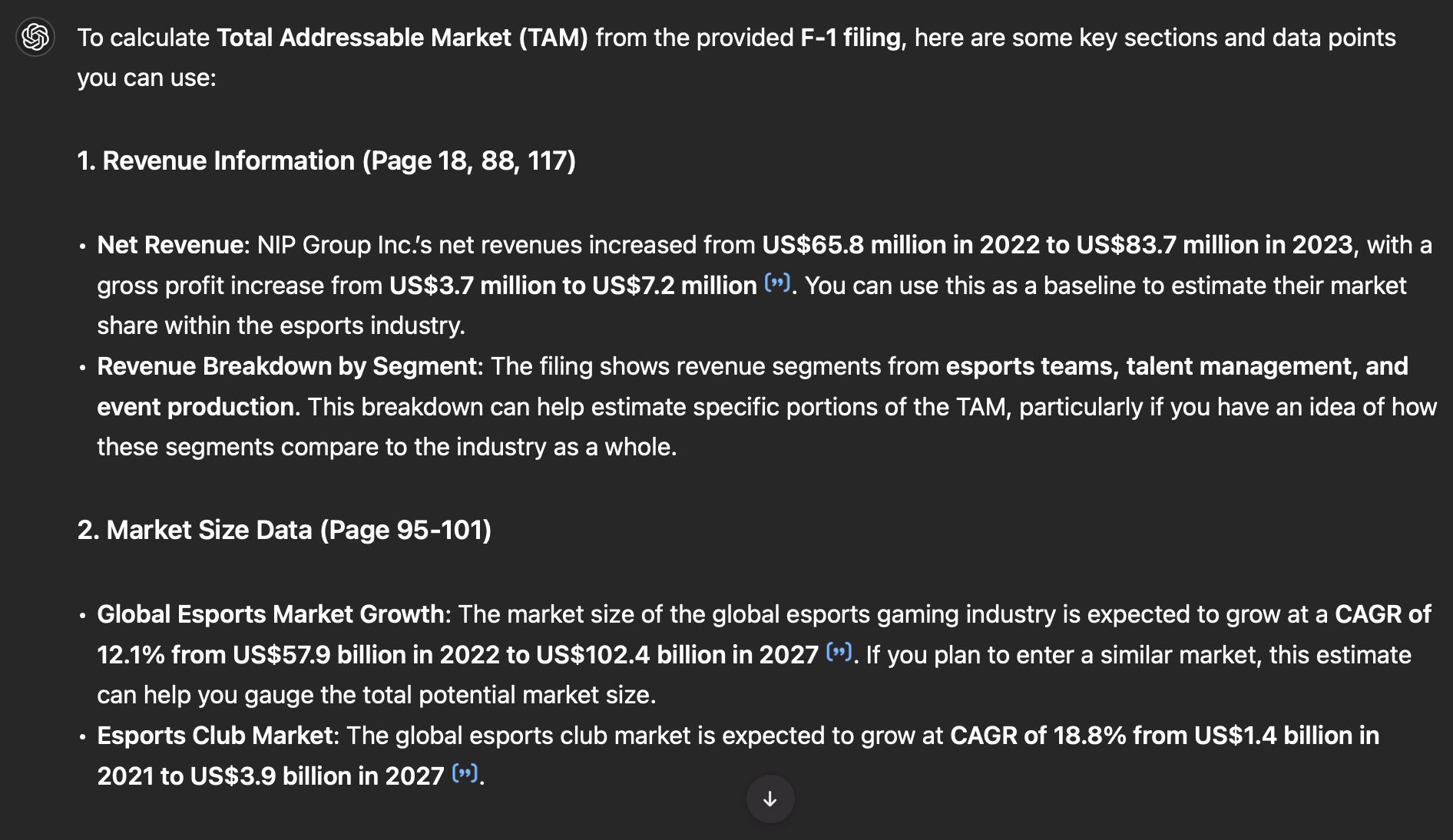
Public companies’ quarterly reports (10-Q) and S-1/F-1 filings offer rich data for estimating TAM. They provide detailed breakdowns of revenue by product line, geographic region, and market segment, along with insights into market share and growth potential.
For example, if a company generates $500 million from a particular service and claims 10% of the market, you can estimate the TAM at $5 billion.
Both reports can also provide guidance on future growth trends, helping forecast your TAM’s evolution.
You can use AI like ChatGPT to analyze the documents for you (they can be quite complex). Here’s a sample analysis of an over 500-page F-1 filing by an Esports company.
Interview potential customers
While reports give you big numbers, talking to real people gives you the practical insights needed to adjust those estimates.
- By speaking directly to customers, you can gauge whether they actually need your product and how likely they are to adopt it.
- Interviews help you narrow down the customer segments most interested in your solution. Maybe not everyone is a fit, but if certain industries or company sizes show more interest, you can focus your TAM on those segments.
- Asking customers what they’d actually pay for your product gives you real data. If you know what your target customers are willing to spend, you can multiply that by the number of similar customers to estimate your revenue potential and refine your TAM.
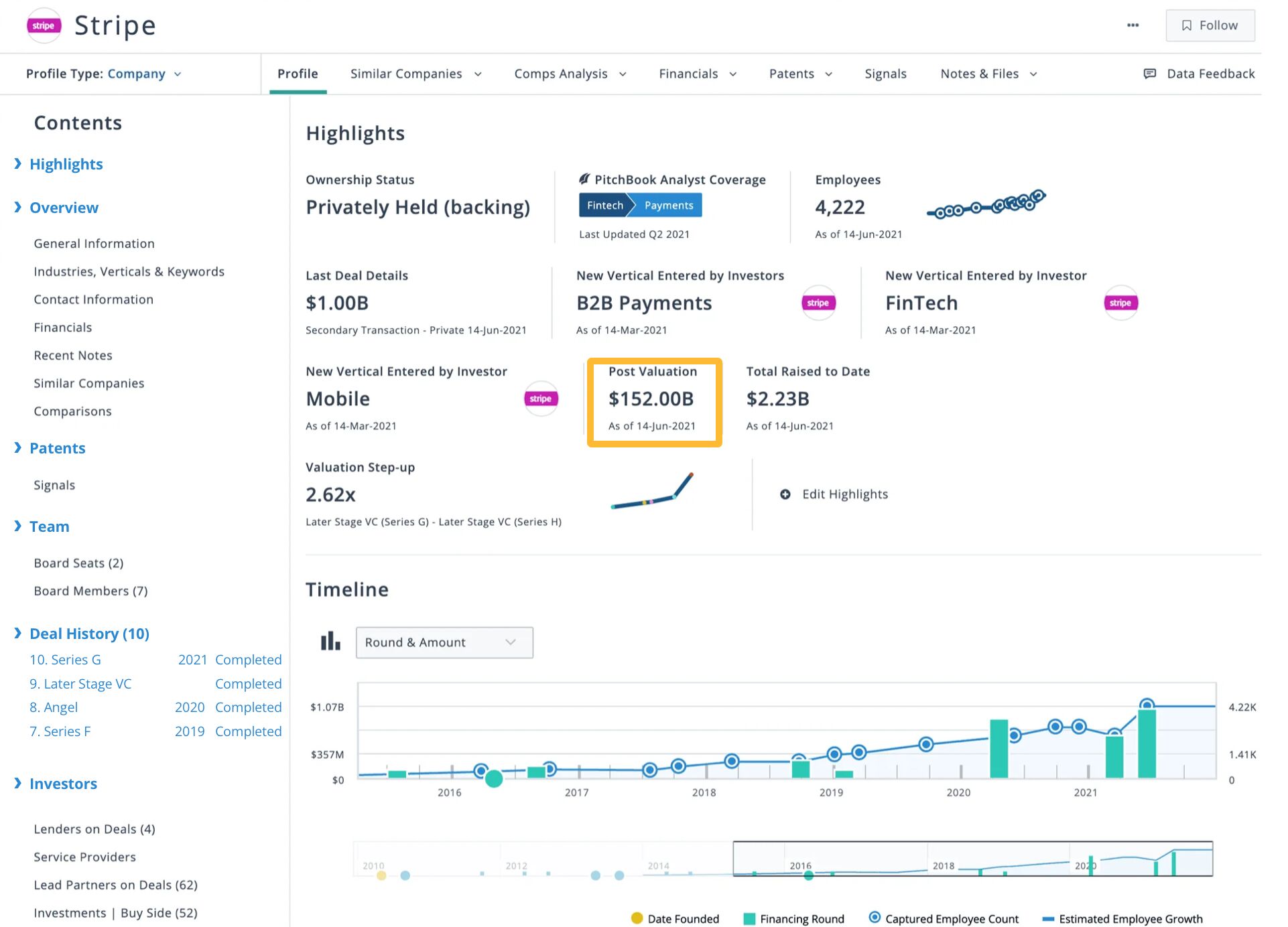
Use PitchBook for investment and market data
PitchBook presents broader market knowledge and funding tendencies. It gives dependable info on market valuations, funding rounds, and trade development, which helps you gauge the general dimension and development potential of a market.
PitchBook additionally helps determine key gamers, making it simpler to estimate how a lot of the market is at present being captured and what stays untapped.
For instance, based mostly on Stripe’s post-valuation of $152 billion and an assumed 30% market share, Stripe’s TAM could be roughly $506.67 billion (TAM = valuation/market share).
Different instruments for SaaS firms
In case you’re in SaaS, there are a pair extra sources of knowledge you could discover particularly helpful: BuiltWith and Latka SaaS Database.
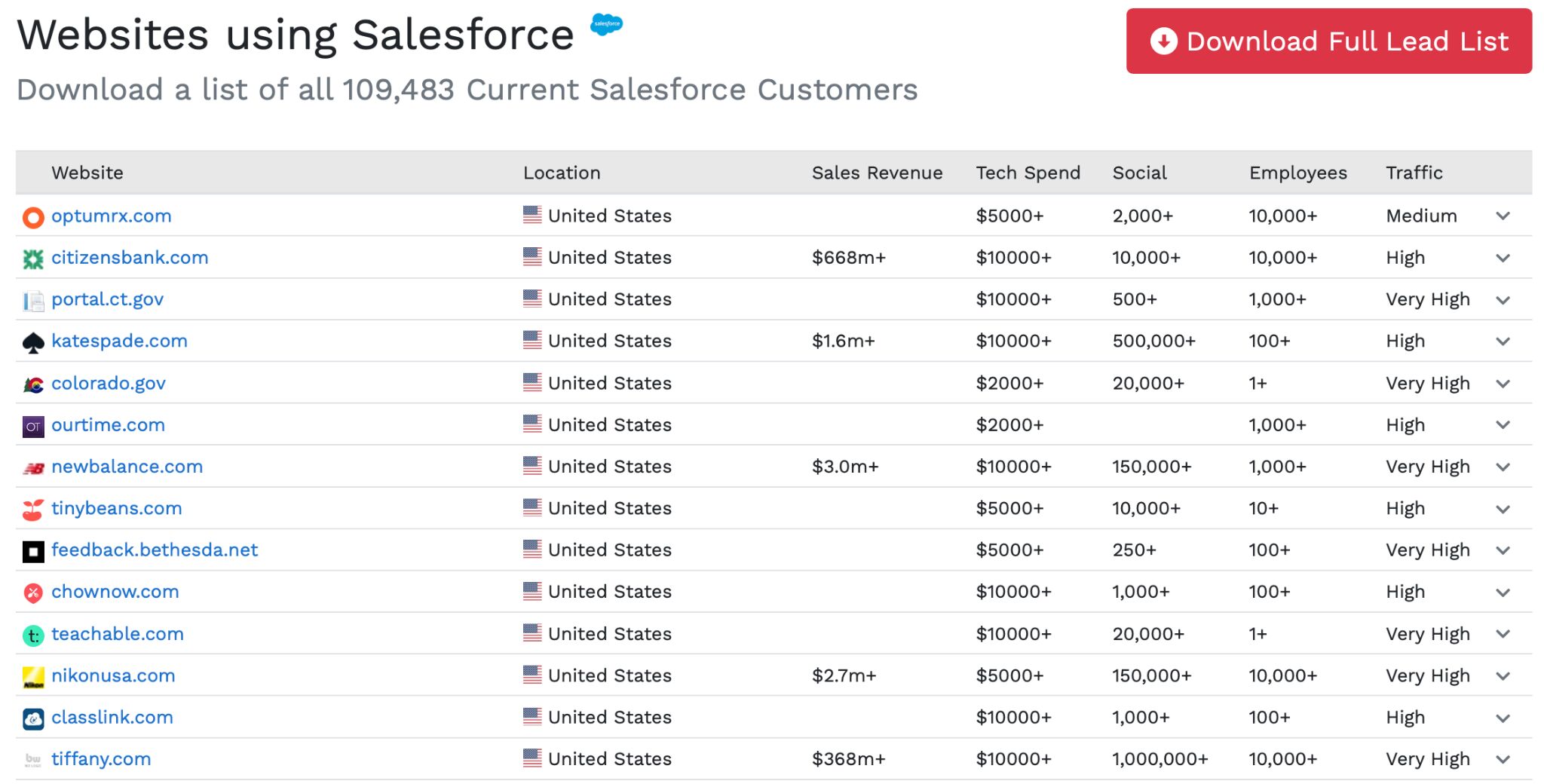
BuiltWith is a instrument that exhibits you what applied sciences web sites are utilizing. This instrument is nice for figuring out your superb buyer as a result of you possibly can see which firms use sure instruments or platforms that align along with your product.
Sidenote.
The Splendid buyer profile (ICP) is an in depth description of the kind of firm or one that would profit most out of your services or products. It’s useful principally for a bottom-up method to calculate market dimension, because it helps you deal with the precise segments of the market which might be most related to your enterprise.
Enter a competitor into BuiltWith, and search for the checklist of their prospects. For instance, listed below are a few of the websites that use Salesforce. You possibly can type the checklist by staff or site visitors to search out the scale of the corporate you suppose you can get on board.
The following one is Latka SaaS Database. In case you can’t discover a SaaS firm on PitchBook or BuiltWith, there’s an opportunity you can find it on Latka. It’s a SaaS-specific database that tracks metrics like income, buyer development, churn charges, and funding for 1000’s of firms.
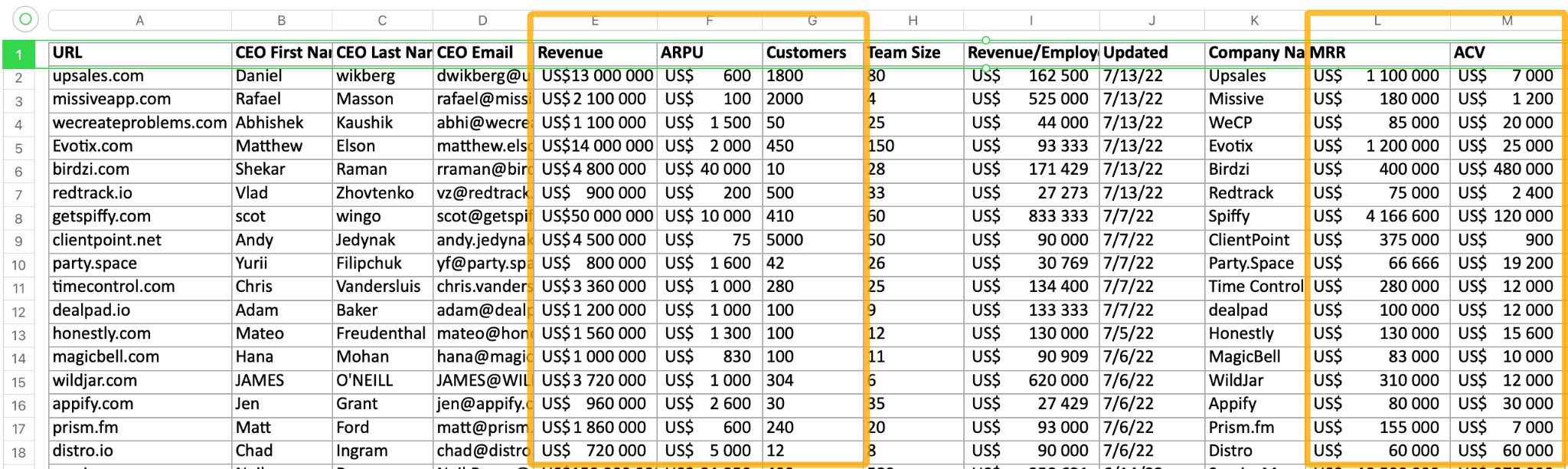
Realizing your rivals’ income and the variety of prospects they serve might help you higher estimate the scale of your potential market.
- Use rivals’ ARPU or ACV (Annual Contract Worth) to estimate your individual future metrics.
- Use the competitor’s income or valuation and apply a market share estimation to calculate TAM.
Ultimate ideas
Keep in mind, TAM is in the end an estimation. It’s pure to be barely off, and also you’ll most likely must reevaluate yearly, after important modifications available in the market or after introducing new merchandise.
Typically, TAM calculations should not very correct. At finest, you’re counting on partially identified variables (variety of potential prospects and common lifetime buyer worth). Industries additionally change so shortly that TAM calculations can grow to be irrelevant inside a matter of months.

What’s maybe extra vital than the precise quantity is the methodology behind your TAM calculation. A well-thought-out method demonstrates how significantly you’re taking the enterprise and the hassle you’ve put into understanding the market.
Obtained questions or feedback? Discover me on LinkedIn.